- 1What maker education actually is
- 2The maker mindset vs. the consumer mindset
- 3Design thinking for kids
- 4Creative projects by age
- 5The role of constraints in creativity
- 6Video and digital creation
- 7Why "just let them play" is creative education
- 8Materials and setup: the low-prep approach
- 9Common creativity-killers to watch for
- 10Why this matters for the future
- 11Getting started this week
- 12Frequently asked questions
Every child is a maker. Before we teach them to stop, with "Don't make a mess," "Follow the instructions," "Color inside the lines", kids naturally build, invent, and create. Maker activities bring that instinct back and channel it into powerful learning.
This guide covers the maker mindset, design thinking for kids, creative projects organized by age, and how to build a creative practice in your home with minimal supplies and low prep. Whether your child gravitates toward building, drawing, coding, or making videos, there's a maker path that fits them.
What maker education actually is
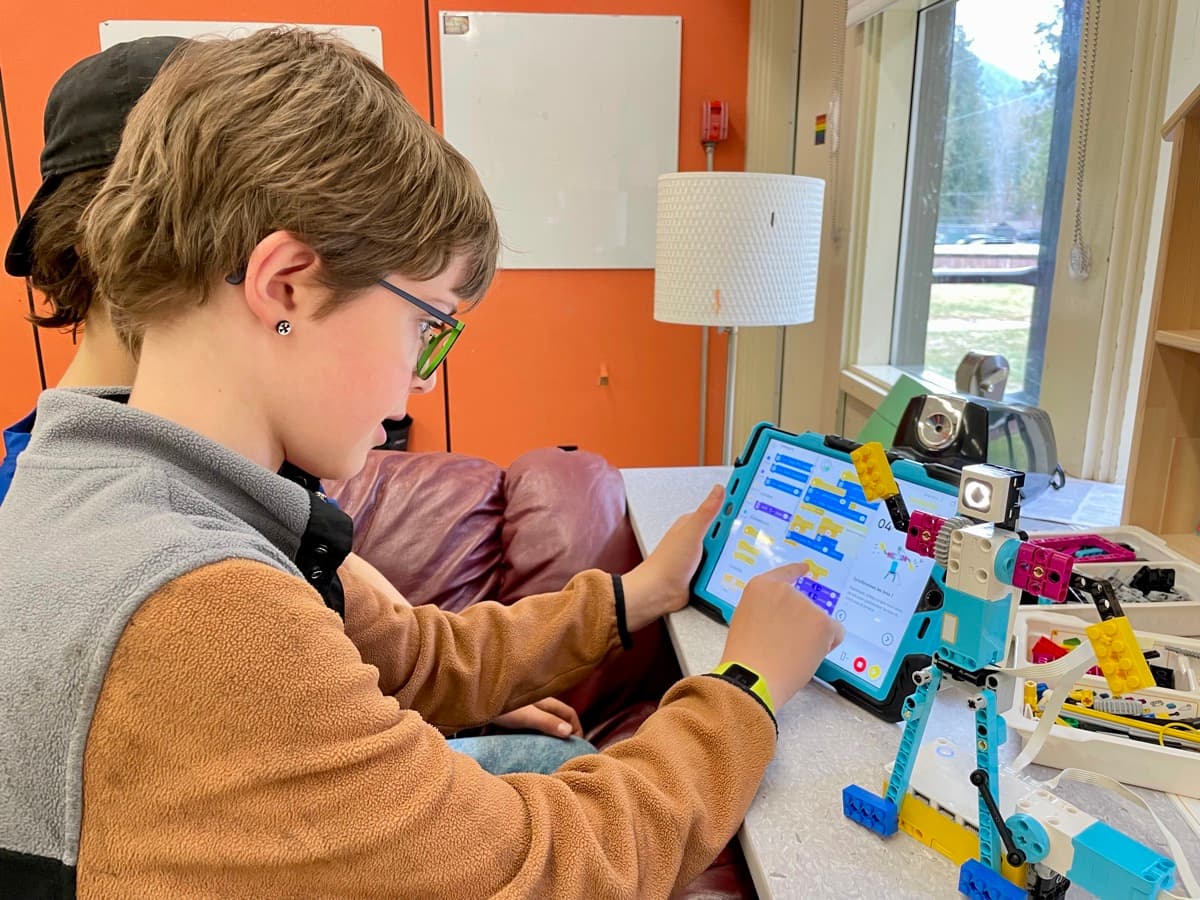
Maker education is hands-on, project-based learning where children build, invent, and create rather than passively consume content. It draws on traditions from constructionism (Seymour Papert's pioneering work at MIT showing that kids learn most deeply when they construct things), the Reggio Emilia approach, and the modern maker movement that spawned makerspaces, fab labs, and creator culture online.
It is not the same as arts and crafts, though crafts can be part of it. The defining feature is that the child is solving a real problem (even a small one) through design, prototyping, and iteration. A child decorating a pre-cut paper plate is doing crafts. A child designing a paper boat that has to carry coins across a bathtub is doing maker education. Both have value; only the second builds design thinking.
Maker education also includes digital making (coding, video, music, graphic design, 3D modelling) alongside physical making. The skills transfer between the two: a child who can plan, prototype, and iterate with cardboard can do the same thing with code. The medium is interchangeable.
The maker mindset vs. the consumer mindset
Here's the most important distinction in creative education: makers create, consumers consume. Both are valid ways to spend time, but they build very different skills. A child watching a YouTube video is consuming. A child making a YouTube video is creating. A child playing a board game is consuming. A child designing a board game is creating.
The maker mindset isn't about rejecting consumption; it's about shifting the default. When your child encounters something interesting, the maker mindset asks: "How was this made? Could I make something like this? What would I do differently?" It transforms every experience from passive reception into active investigation.
This matters because the world increasingly rewards creators over consumers. The ability to build something, whether a product, a solution, a piece of art, a business, is what separates people who shape their world from people who simply live in it. That's not just a career skill. It's a life skill. And it starts with a cardboard box and a pair of scissors.
We wrote about raising creative kids and what the research says about nurturing this mindset from an early age. The short version: creativity isn't a talent some kids have and others don't. It's a habit that gets stronger with practice, and weaker with disuse.
Design thinking for kids
Design thinking is a fancy term for something kids do naturally when we let them: identify a problem, brainstorm solutions, build a prototype, test it, and improve it. It's the process behind every great invention, and it's completely teachable to children of any age.
The design thinking cycle
- 1Empathize: Who has the problem? What do they need? (For younger kids: "What's the problem we're trying to solve?")
- 2Define: What exactly are we trying to do? What are the constraints? ("Build a boat that can carry 10 pennies across the bathtub without sinking")
- 3Ideate: Brainstorm solutions. No judgment yet; wild ideas welcome. Sketch, talk it out, or just start grabbing materials
- 4Prototype: Build a rough version. It doesn't need to be pretty; it needs to be testable
- 5Test: Does it work? What happened? What broke? What surprised you?
- 6Iterate: What would you change? Build version 2. And 3. And 4. Each version teaches more than the last
You don't need to formally teach these steps. Just pose challenges that naturally require them. "Design a container that keeps an ice cube from melting for an hour." A child working on that problem will empathize (the ice cube is melting!), define (it needs insulation), ideate (towels? aluminum foil? a cooler made of cardboard?), prototype, test, and iterate, all without knowing they're using a framework that Fortune 500 companies pay consultants to teach.
The project-based learning approach is a natural fit here. Instead of isolated craft projects, give kids multi-day challenges that require planning and revision. The depth of learning in a week-long project far exceeds what happens in ten separate crafts.
In the Membership
Board Game Studio
Creativity project for kids ages 6-14: design, build, and playtest an original board game from scratch. Low-prep, open-ended.
Creative projects by age
Creativity doesn't have grade levels, but it does have developmental stages. Here's what works at different ages, not as limits, but as starting points. Every child is different, and a 6-year-old with building experience might tackle a challenge designed for 10-year-olds.
Ages 3-5: sensory exploration and open-ended building
At this age, the process IS the product. Don't worry about the outcome; focus on providing materials and space. Playdough, water play, block building, collage-making, painting, and free-form construction with cardboard and tape. The key is open-ended materials (blocks, art supplies, natural objects) rather than kits with one "correct" result.
Simple challenges work well: "Can you build a house for this toy animal?" "Can you make something taller than you?" "Can you mix two colors to make a new one?" Keep challenges short (5-15 minutes) and celebrate the attempt, not the result.
Ages 6-8: purposeful building and early design
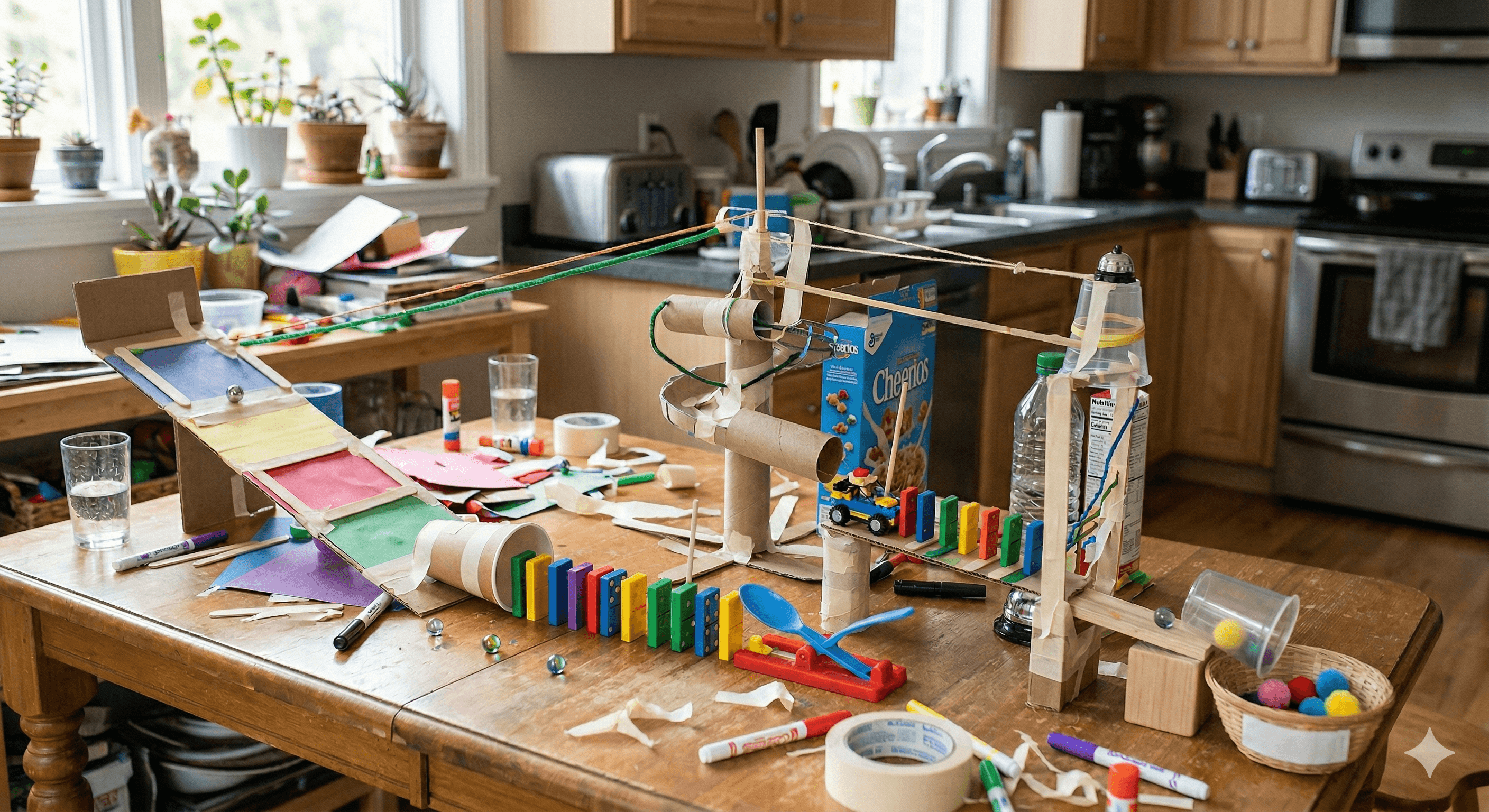
Kids in this range can handle challenges with specific goals: build a bridge that holds a book, design a marble run, create a board game, or invent a new animal and build its habitat. They're developing the ability to plan before they build and to revise when something doesn't work. Tools become important: scissors, rulers, simple hand tools with supervision.
This is also the prime age for "inventor's journals," notebooks where kids sketch ideas, plan projects, and record what they've built. The journal becomes a portfolio of their creative thinking over time.
Ages 9-11: complex projects and real-world application
Now kids can take on multi-step projects that span days or weeks. Design and sew a simple garment. Build a working catapult. Create a stop-motion animation. Write and illustrate a graphic novel. Program a simple video game. At this age, kids can also start solving real problems, such as designing a better organization system for their room, building a birdhouse from a plan, or creating a family recipe book.
Ages 12+: independent creation and digital making
Older kids are ready for sustained creative projects with real audiences. A YouTube channel, a podcast, a small business selling handmade goods, a community mural, a website, or a short film. The tools expand to include digital creation: video editing, graphic design, coding, 3D printing if available. The maker mindset at this age starts to look a lot like entrepreneurship.
The role of constraints in creativity
"You can make anything you want" is actually a terrible creative prompt. It's too open; most kids (and adults) freeze when faced with unlimited possibility. Constraints are what unlock creativity. They give the brain something to push against, and that resistance is where inventive thinking happens.
The best maker challenges include specific constraints: material limits ("using only newspaper and tape"), time limits ("you have 20 minutes"), functional requirements ("it has to hold water"), or rule-based restrictions ("your game can only have three rules"). Each constraint eliminates easy solutions and forces your child to think more creatively.
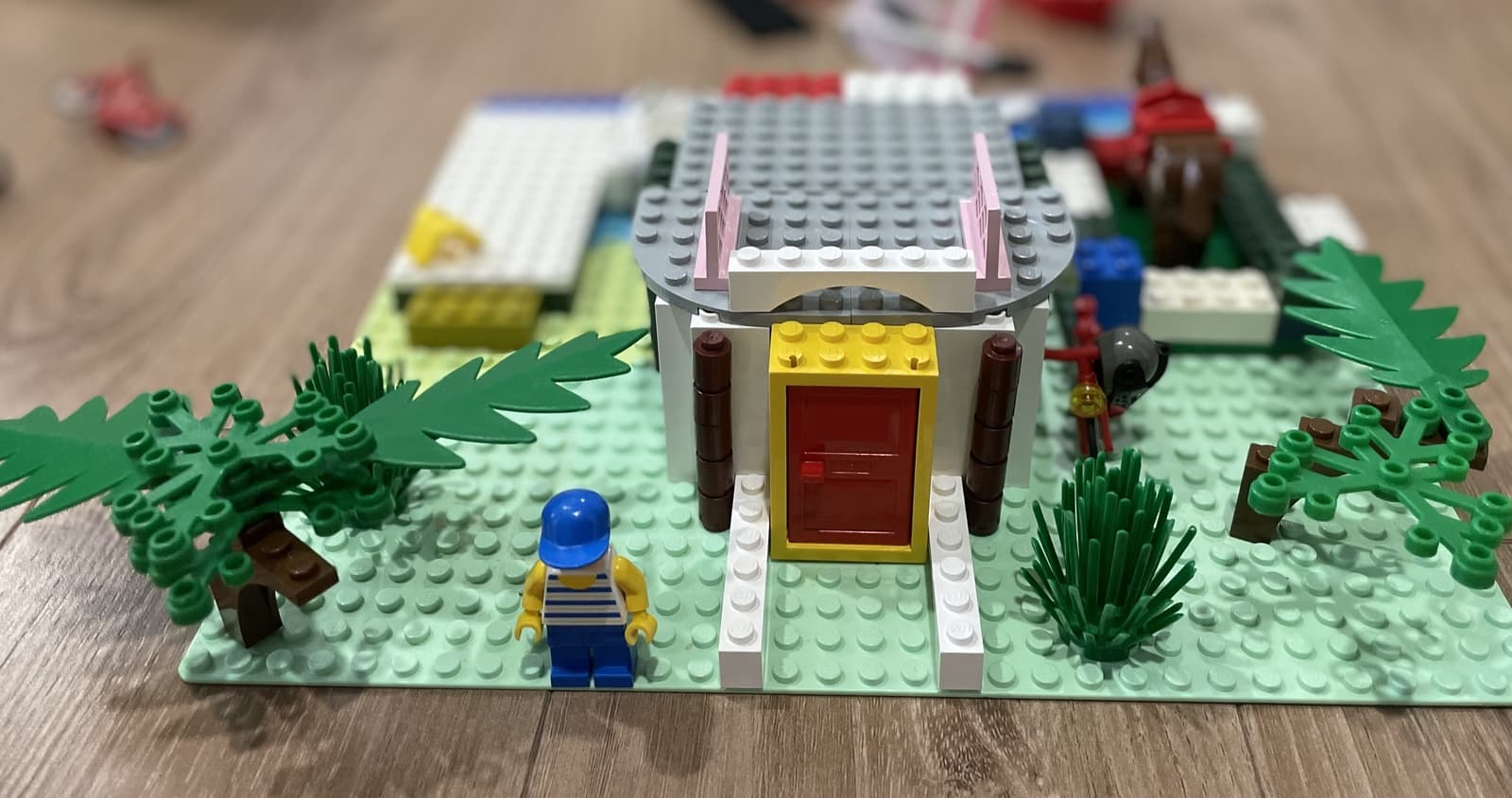
This is why LEGO sets with instructions and free-build LEGO serve different purposes. The instructions teach following a plan. The free-build with limited pieces teaches creativity under constraint. Both are valuable, but the second one is where maker thinking really develops.
Time limits are magic for reluctant makers. "You have 10 minutes to build the tallest structure you can" removes the pressure of perfection. It can't be perfect; there's not enough time. So kids just build, and that's exactly what you want.
In the Membership
Build a Rube Goldberg Machine
STEM engineering project for kids ages 6-14: build an absurdly complicated machine to do something simple. Design thinking, cause-and-effect, and creativity meet.
Video and digital creation
Making videos is one of the most comprehensive creative projects a child can undertake. It involves writing (scripts), design (set and costume), technology (camera and editing), performance (acting or presenting), and project management (organizing everything into a finished product). It's a maker activity that doesn't look like a maker activity.
Our deep dive on kids making videos as a learning tool covers how to support video creation at different ages, from simple stop-motion animations for young kids to planned and edited productions for older ones. The key insight: the quality of the video doesn't matter. The learning is in the process: planning, problem-solving, and iterating until it works.
Digital creation also includes coding, digital art, music production, podcast creation, and web design. These aren't separate from "real" making; they're the modern expression of the same builder instinct. A kid designing a video game level is doing the same kind of creative problem-solving as a kid building a fort. The medium is different; the thinking is the same.
In the Membership
Create a Mini Movie or Radio Drama
Creativity project for kids ages 6-14: create a mini movie, stop-motion, or radio drama, from script to premiere.
Why "just let them play" is creative education
Unstructured play is the foundation of creativity. When a child spends an afternoon turning a cardboard box into a spaceship, they're practicing imagination, spatial reasoning, narrative thinking, and problem-solving, without any adult direction at all.
We wrote about why just letting kids play counts as education because it's the part of creative learning that makes parents most anxious. It doesn't look productive. There's no worksheet to show for it. But the research is clear: the American Academy of Pediatrics 2018 clinical report "The Power of Play" documents how unstructured play builds executive function, problem-solving, creativity, and emotional self-regulation, the exact skills children need for self-directed learning.
The trick is providing an environment that invites creation: accessible materials, enough space, and enough time. Creativity can't be rushed into a 15-minute slot between math and lunch. It needs breathing room. Some of the best creative breakthroughs happen when a child is "bored" enough to invent their own entertainment.
Boredom is not the enemy of creativity; it's the prerequisite. Every great idea starts in the gap between stimulation, where a child has to fill the silence with their own imagination.
Materials and setup: the low-prep approach
One of the biggest barriers to maker activities is the myth that you need a dedicated makerspace, expensive tools, or specialized materials. You don't. The best maker kit in the world is a recycling bin, a roll of tape, and a pair of scissors.
The essential maker supply list
- Cardboard (save boxes, cereal boxes, shipping materials, all free)
- Tape (masking tape, painter's tape, and clear tape cover most needs)
- String, yarn, or twine
- Scissors (good ones, because dull scissors kill motivation faster than anything)
- Glue (white glue for young kids, hot glue for supervised older kids)
- Paper in various sizes
- Markers, colored pencils, crayons
- Rubber bands, paper clips, clothespins
- Natural materials collected on walks (sticks, leaves, stones, pinecones)
- Recycled containers (yogurt cups, bottles, egg cartons)
Store these in one accessible spot: a bin, a shelf, a corner of a room. The materials should be where kids can grab them independently, without asking permission. When creation requires a request form, it doesn't happen spontaneously. And spontaneous creation is where the magic lives.
One more thing about setup: accept the mess. Maker activities are inherently messy. If cleanliness is your top priority, creativity will suffer. Find a space where mess is okay, such as a garage, a porch, or a dedicated corner with a tarp, and let it be the chaos zone. Clean up together afterward, but during the making, let it be wild.
Common creativity-killers to watch for
Parents do not kill creativity on purpose. We do it accidentally, usually with small comments that add up. Things to watch for:
- "That is not how you do it." Usually said when a kid is doing something creative in a way you would not. The whole point is that they are doing it differently. Let them.
- "Are you sure?" (asked twice). Asking once is fine. Asking twice tells them you do not actually trust their judgement. They stop trusting it too.
- "Let me help you fix that." If they have not asked for help, do not fix it. The wonky tower they built teaches them something the perfectly straight one would not.
- "What is it supposed to be?" This question makes art a quiz with a right answer. Try "Tell me about it" instead. Open-ended.
- Premature evaluation. Praising or critiquing too early shifts the child's focus from creating to performing. Wait until they ask what you think, or until the project is done.
- Too many materials. Counterintuitively, a giant box of supplies can overwhelm a child into inaction. A small focused set of materials with a clear challenge produces more creative output.
- Schedule pressure. Creativity needs unrushed time. A creative project shoehorned into a 20-minute slot between activities will not produce much.
The goal is not perfection in how you respond, just awareness. Most parents do most of these sometimes. Just notice when you are doing them and ease off.
Why this matters for the future
Creative thinking is now consistently ranked among the most valuable workplace skills for the coming decade. The World Economic Forum's Future of Jobs Report 2025 lists analytical thinking, creative thinking, and resilience as the top three skills employers expect to need most. As AI automates routine cognitive work, the parts of human thinking that AI cannot replicate (originality, judgement, taste, the ability to ask the right question) become more valuable, not less.
Beyond the career argument, there is a quality-of-life one. Adults who have a creative practice (any practice: writing, music, woodworking, gardening, cooking, designing) report higher life satisfaction. Building the maker habit in childhood gives kids a lifelong source of meaning that does not depend on consumption or external validation. That is worth the cardboard mess on its own.
Getting started this week
You don't need to plan an elaborate maker day. Just pose a challenge tonight at dinner and see what happens.
Want ready-to-use activities? Browse our free printable creative and maker checklists for kids.
- 1Pick one challenge from this list: build the tallest tower from recycled materials, design a board game, create a marble run from cardboard tubes, or invent a new tool that solves a problem in your house
- 2Set a time limit (30-60 minutes works well for a first challenge)
- 3Provide basic materials and step back. Resist the urge to help unless asked
- 4When they're done (or time is up), ask three questions: What worked? What didn't? What would you do differently?
- 5Display the creation somewhere visible, regardless of how it turned out. Making visible means making valued