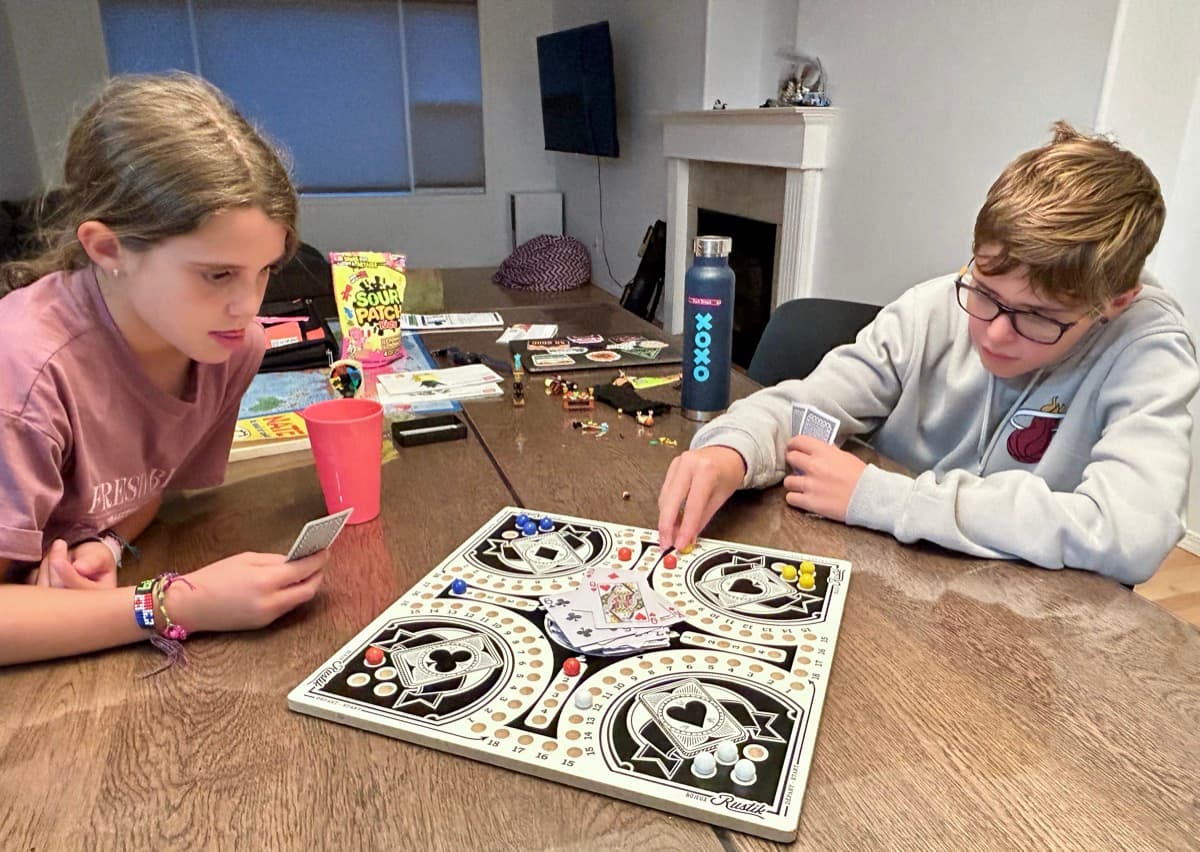
Picture this: a rainy afternoon, no screens, a piece of cardboard, some markers, and a handful of dried beans. Two hours later, a kid has a fully functioning board game, complete with themed cards, a scoring system, and a penalty mechanic that sends you back three spaces.
A sibling plays it. Finds loopholes. Argues the scoring is unfair. Rules get revised three times before dinner.
That afternoon involves more maths, writing, logic, negotiation, and design thinking than a week of worksheets. And nobody calls it school.
Why game design is secretly powerful learning
When a child designs a board game, they’re doing something remarkable: they’re building a system. A game is a set of rules that interact, create choices, and produce outcomes. That’s systems thinking, the same skill that engineers, programmers, economists, and scientists use every day. It’s also one of the clearest ways to raise genuinely creative kids without buying a single craft kit.
But here’s what makes it special for kids: the feedback loop is immediate. You design a rule, you play the game, you see if it works. If the game is boring, you change something. If one player always wins, you rebalance. If the rules are confusing, you rewrite them. That cycle, design, test, revise, is the core of design thinking, and kids do it naturally when the project is a game they actually want to play.
- Maths: probability, scoring systems, resource management, counting, addition, multiplication
- Writing: clear rule-writing, storytelling, flavour text, sequencing instructions
- Logic: if-then reasoning, game balance, strategy vs. luck, edge cases
- Art and design: board layout, card design, visual hierarchy, colour coding
- Social skills: playtesting with others, receiving feedback, negotiation, fairness
How to start: the simplest possible game
Don’t start with a complex strategy game. Start with the simplest thing that counts as a game: a path, a way to move, and a way to win. That’s it.
Here’s a 20-minute version that works for ages 5 and up:
- 1Draw a winding path of 20–30 spaces on cardboard or a large piece of paper
- 2Mark a START and a FINISH
- 3Make 10 simple cards (e.g., “Move forward 2,” “Go back 1,” “Skip a turn,” “Move forward 3”)
- 4Find something to use as player pieces, buttons, coins, dried beans, LEGO figures
- 5Play it. See what happens
This bare-bones version is where the magic starts. Within one playthrough, your child will start saying things like “this is too easy” or “we need a shortcut” or “what if there’s a space where something special happens?” Those observations are the beginning of game design.
Building complexity (let them lead)
Once the basic game exists, step back and let your child add complexity. Don’t suggest it, wait for them to feel the need for it. Boredom with the current version is the best motivator for innovation.
Common additions kids come up with on their own:
- Special spaces that trigger events (“Volcano! Everyone moves back 2”)
- Resource collection (gather coins, trade them for power-ups)
- Choice points (“Do you take the shortcut through the swamp or the safe route around?”)
- Different player abilities (“The explorer moves 3 but can’t use shortcuts; the pilot moves 2 but can fly over obstacles”)
- A theme and backstory (suddenly it’s not just a path; it’s a quest through a haunted forest)
Kids surprise you with complexity. A 9-year-old might add an entire economy to a game about running a bakery, players earn coins for baking, spend them on ingredients, and invest in upgrades like a bigger oven. That’s basic business maths, and they’re completely absorbed in it without realising they’re learning.
In the Membership
Board Game Studio
Creativity project for kids ages 6-14: design, build, and playtest an original board game from scratch. Low-prep, open-ended.
The playtesting lesson (this is where the real learning lives)
Playtesting is where game design becomes genuinely educational. When your child watches someone else play their game, they encounter a brutal truth: other people don’t think like you do.
Rules that seemed perfectly clear turn out to be ambiguous. Strategies that seemed balanced turn out to be broken. Cards that seemed fun turn out to be confusing. This is not failure, this is the exact experience that professional game designers, software engineers, and product developers go through every day. Learning to observe how others interact with your creation, and then improving it based on what you see, is one of the most valuable skills a person can develop.
Playtesting teaches something no worksheet ever will: other people don’t think like you do. And that’s not a problem to fix; it’s information to design with.
After each playtest, ask your child three questions: What worked? What didn’t work? What would you change? Then let them change it and test again. That cycle can repeat for days, and each iteration makes the game, and the designer, better. The same iteration loop shows up any time kids create for a real audience, including when they make videos to teach what they’ve learned.
Adapting for different ages
Ages 4–6: Pattern and colour games
Young kids can design matching games, simple path games, or card games based on colours and shapes. The rules will be chaotic and change mid-game. That’s fine. The creative process matters more than the final product at this age.
Ages 7–9: Theme and story games
This is the sweet spot for board game design. Kids can write rules, create themed cards, design boards with multiple paths, and playtest meaningfully. They’re old enough to handle feedback and young enough to be wildly creative.
Ages 10+: Strategy and system games
Older kids can tackle resource management, probability, card drafting, and complex scoring. They might create games that genuinely challenge adults. If they’re interested, introduce them to existing game design frameworks, there are free resources online for aspiring game designers of all ages. The same maker mindset shows up when kids invent their own sport, where the rules and fairness come from them, not from a coach.
You don’t need a game design kit. Cardboard, paper, markers, scissors, tape, dice, coins, dried beans or pasta for pieces, and index cards for game cards. That’s everything. Some of the best kid-made games use nothing but scrap paper and a pen.
From game night to game design studio
If your family already plays board games together, you’re halfway there. Next time you play, pause and ask: “If you could change one rule, what would it be?” or “What would make this game better?” That question, “how would I improve this?”, is the bridge from playing to designing.
You might be surprised at how quickly kids go from modifying existing games to creating their own. And once they start, good luck stopping them. Some kids end up with a stack of cardboard prototypes that rivals the family’s published game collection. Each one teaches them something, about maths, about people, about the satisfaction of making something that works.
So grab some cardboard. Clear the kitchen table. And let them build a world with rules, their rules, that other people want to play in. That’s not a rainy day activity. That’s serious learning disguised as the best afternoon ever.
Want this as a free printable? Grab the 26 Creative & Maker Ideas for Kids, free to read, and the printable version lands in your inbox.