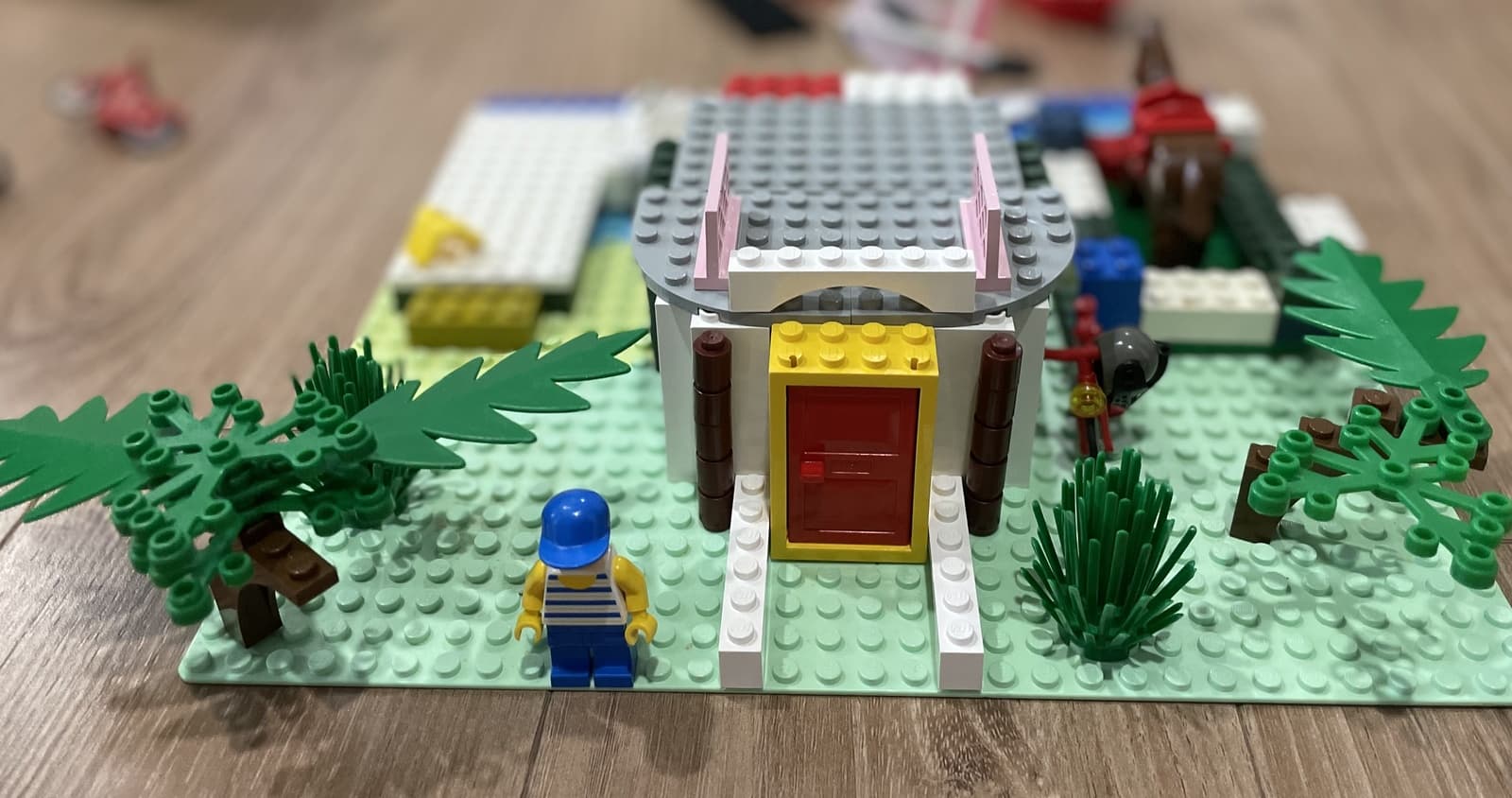
My son built an imaginary island, divided into parts based on everything he loves: Candyland, Sportland, Woodland (representing home and family). Each section has its own rules, its own landscape, its own logic. It started as a drawing and kept growing because nobody told him to stop.
My daughter built a magical world, inspired by Harry Potter and Avatar, with a magic school, magic creatures, and a magic tree at the centre of it all. She’ll add to it for weeks, then leave it alone, then come back with a whole new layer of detail.
When people ask me what worldschooling “looks like,” I sometimes show them these worlds. Because this is what happens when a kid has time, freedom, and a brain that wants to understand how things work, they build a world of their own.
Why worldbuilding is deep learning
Worldbuilding looks like play. It looks like a kid drawing maps and making up stories. And it is play, but it’s also one of the most intellectually demanding creative activities a child can engage in.
To build a believable world, you have to think about geography (where are the rivers? why do cities form where they do?), economics (how do people trade? what resources exist?), politics (who makes decisions? how is power distributed?), culture (what do people value? what stories do they tell?), and ecology (what lives here? how does the climate affect the landscape?).
That’s not a list of school subjects. That’s a list of thinking skills that transfer to every area of life. And kids develop them naturally through worldbuilding because every decision they make creates new questions: if this mountain range blocks rain, then this side will be dry, which means the people there need a different food source, which means they probably trade with the coast, which means they need a road or a river route...
That chain of reasoning, from geography to economics to infrastructure, is systems thinking at its finest. And a 10-year-old can do it, unprompted, for hours.
- Writing: narrative, descriptive, procedural, and persuasive writing in a meaningful context
- Geography: terrain, climate, resources, mapping, spatial reasoning
- History: timeline construction, cause and effect, understanding how societies change
- Economics: trade, resource management, supply and demand, currency
- Logic: internal consistency, if-then reasoning, rule systems
- Systems thinking: understanding how interconnected parts affect each other
How to encourage it (without assigning it)
You cannot assign worldbuilding. If you say “this week, your project is to create an imaginary world,” you’ll get a half-hearted map drawn in 20 minutes. Worldbuilding only works when it comes from genuine interest. Your job is to notice the sparks and fan them gently.
Signs your child is already worldbuilding (even if they don’t call it that):
- They draw maps of imaginary places
- They create elaborate backstories for toys, LEGO sets, or game characters
- They invent languages, flags, or currencies
- They build complex Minecraft worlds with rules and systems
- They write stories set in the same universe over and over
- They spend ages explaining how their imaginary world “works” to anyone who’ll listen
If you see any of these, lean in. Ask questions. Be the interested audience. “Tell me about the government. Why did you choose a monarchy? What happens if the king makes a bad decision?” These questions don’t feel like school. They feel like someone caring about something your child made. And that caring is what fuels the next layer of depth.
From play to project
My son’s island started as a doodle. It became a project because I took it seriously. When he showed me his first map, I didn’t say “that’s nice.” I said “What happens between Candyland and Sportland? Who lives in Woodland?” He didn’t know yet. So he went and figured it out.
Here’s what helped it grow from a doodle into a year-long intellectual project:
- A dedicated notebook: giving the world its own physical space signals that it matters
- Genuine questions from adults: not testing questions, but curious ones
- Related books and content: reading about real places, watching movies, playing games, all of it feeds the imaginary world with new ideas and details
- No deadlines or deliverables: the project grows when they’re inspired, not when someone tells them to work on it
- Sharing opportunities: letting them present their world to grandparents, friends, or a family blog gives the project an audience and a purpose
When a child builds an imaginary world with themed regions, magic systems, and its own internal logic, they’re not just playing. They’re teaching themselves how real worlds work.
Different types of worldbuilding
Worldbuilding doesn’t have to look like a notebook full of maps (though it can). There are many entry points, and different kids gravitate to different ones:
Map-makers
Some kids start with geography. They draw continents, rivers, mountain ranges, and coastlines. The world grows from the landscape outward. These kids tend to be spatial thinkers who love atlases, globes, and Google Earth.
Storytellers
Some kids start with characters and narratives. They create a hero, place them in a world, and build outward from the story. The geography, politics, and culture develop because the story needs them. These kids tend to be writers and readers who get lost in books.
Game designers
Some kids build worlds through games, board games, role-playing games, video games, or Minecraft. The world exists as a system of rules, challenges, and rewards. These kids are often logical thinkers who enjoy puzzles and strategy.
Digital builders
Minecraft, Roblox, and similar tools let kids build worlds in three dimensions with functional systems. A child who creates a working farm, a village with trading posts, and a railway system in Minecraft is worldbuilding, and engaging with engineering, logistics, and urban planning. The digital format doesn’t make it less valid. The thinking is the same.
In the Membership
Build an Imaginary World
Creativity project for kids ages 6-14: create an entire imaginary world with geography, creatures, rules, and stories.
Real examples from real families
Worldbuilding shows up in so many forms across the families in our community:
- A 7-year-old who created an entire animal kingdom with species she invented, including food chains and habitat maps
- Twin 10-year-olds who run competing “countries” and negotiate trade deals at the dinner table
- A 13-year-old who built a civilisation in Minecraft complete with a parliament building where his friends vote on server rules
- An 8-year-old who draws the same imaginary city from different time periods, medieval, Victorian, futuristic, showing how it changes
- My daughter who built a magical world with a school for wizards, enchanted creatures, and a sacred tree at its heart, all inspired by her favourite books and movies
Every one of these projects involves writing, geography, history, economics, and logical thinking. None of them were assigned. All of them were driven by genuine creative passion, the kind of learning that sticks because it matters to the child.
Give your child a blank notebook and one question: “If you could create any world, what would it be like?” Then leave them alone. Check in later. Ask about their world with genuine curiosity. That’s it. No templates, no rubrics, no expectations. Just space, a question, and an interested audience.
The learning you can’t assign
There’s a type of learning that only happens when a child is so absorbed in something that they forget they’re learning. Worldbuilding is one of the purest forms of this. A kid who’s inventing a government for their imaginary country is studying political science. A kid who’s drawing a map with rivers and mountains is studying physical geography. A kid who’s designing a currency system is studying economics.
They’re just not calling it that. And that’s fine. The labels don’t matter. The thinking does.
So the next time your child spends an hour drawing maps of places that don’t exist, or explaining the complex social hierarchy of their imaginary world, don’t worry that they’re “wasting time.” They’re doing some of the most sophisticated intellectual work of their lives.
And they’re having a brilliant time doing it.
Want this as a free printable? Grab the 26 Creative & Maker Ideas for Kids, free to read, and the printable version lands in your inbox.