If you are reading this, you are probably not sure. That is the most honest and healthy place to start. Homeschooling is a big decision, and the internet is full of people who will tell you it is the best thing they ever did. Some of that is true. But a decision this size deserves better than a sales pitch.
I taught in classrooms for fifteen years before I ever homeschooled my own kids, so I have watched this choice from both sides of the desk. This checklist is not here to convince you. It is here to help you decide honestly, including the parts most homeschool blogs leave out, like the signs it might not be the right time for your family.
There is no universally right answer
Homeschooling is right for some kids and some families, and genuinely wrong for others. The same family can be a yes one year and a no the next. The goal is not to find the objectively best form of education. It is to find the best fit for your child, your capacity, and this particular season of your life. Anyone who tells you homeschooling is always the answer is selling something, and so is anyone who tells you it never is.
Signs homeschooling might be a good fit
None of these on its own is a verdict. But if several feel familiar, homeschooling is at least worth a serious look.
- Your child is fine at home but shrinks at school. Morning stomachaches, rising anxiety, a spark that is quietly dimming. School may not be working for who they are right now.
- Your child is bored or out of step. Whether they are ahead, behind, or just wired differently, a class of thirty cannot move at one kid’s pace. Home can.
- You want more time together, not less. You would rather have your kid’s days than hand the best hours over to a school schedule. That pull matters more than people admit.
- Your family’s life does not fit a school calendar. Shift work, travel, a business, a move, a health situation. Flexibility is the whole point.
- You are already doing it in spirit. If your evenings and weekends are full of the real learning your kid loves, formal school can start to feel like the thing in the way.
Signs it might not be the right time (the part nobody writes)
Here is the honest bit. Homeschooling is not a rescue hatch for every hard season, and choosing not to right now does not make you a worse parent.
- You are in the middle of a crisis. A new baby, a divorce, a health emergency, a financial cliff. Adding "run a school" on top rarely ends well. It is okay to wait.
- You are choosing it only out of fear. Fear of the world, of a bad teacher, of one rough year. Fear can be a useful signal, but "away from" is a shaky foundation. "Toward" holds up better.
- You have zero capacity and no support. You do not need to be home all day, but someone has to lead. If there is truly no adult bandwidth and no co-op, tutor, or community to lean on, name that honestly.
- Your kid is a hard no and old enough to mean it. A resentful thirteen-year-old pulled from their friends makes for a long year for everyone. Their voice counts.
Choosing not to homeschool right now does not make you a worse parent. Choosing it for the wrong reasons does not make you a better one.
The four fears that stop most parents
Am I even qualified?
You do not need a teaching degree. I have one, and I can tell you the classroom skills that matter least at home are the credential ones. What a kid needs is an adult who cares, who is willing to say "I don’t know, let’s find out," and who can track down a good resource. You are the expert on your own child, and that is the qualification that is hardest to replace.
What about socialization?
The real question underneath is "will my kid have friends and know how to be around people?" The answer is yes, if you make it happen, the same way you would for any child. Co-ops, sports, clubs, neighbours, mixed-age play. Homeschooled kids often get more real-world social practice, with all ages rather than just the twenty-nine people born the same year, not less.
Can we actually afford it?
Homeschooling can cost almost nothing or quite a lot, depending on your choices. A library card, the outdoors, and everyday life cover an enormous amount for free. The bigger cost is usually income, if it means one parent works less. That is a real math problem worth doing honestly before you decide, not an automatic reason to rule it out.
What if I ruin them?
This is the fear underneath all the others. Here is the reassuring truth: kids are resilient, learning is not fragile, and almost nothing in these years is un-fixable. A year of homeschooling that does not go perfectly is not a catastrophe. Neither is a year of school. You are allowed to try, adjust, and even change your mind.
In the Membership
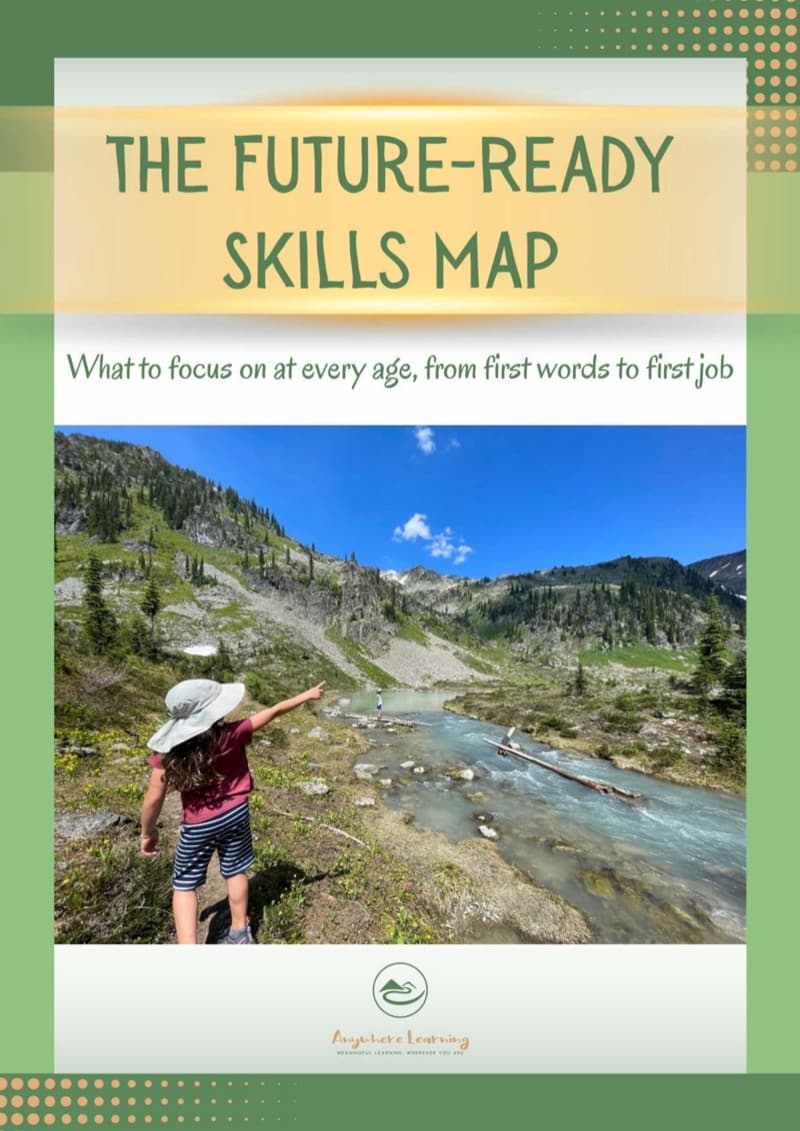
The Future-Ready Skills Map
Not sure what to actually focus on if you do homeschool? This maps the future-ready skills that matter most by age, so you are building toward something instead of just recreating school at home.
You do not have to go all in
The biggest myth is that this is a binary: full-time homeschool or nothing. It is a spectrum, and most families live somewhere in the middle.
- Afterschooling: keep school, and add the real-world learning at home in the evenings and on weekends.
- A trial term: commit to one semester, then reassess. Nothing has to be permanent.
- Hybrid or part-time programs: some schools and co-ops run two or three days a week.
- Worldschooling: learning through travel for a season (here is how homeschooling and worldschooling differ).
- A gap year: pull out for one intentional year and see what you learn about your kid.
You can also start and stop. Plenty of families homeschool for a few years and return to school, or the reverse. The door swings both ways, and walking through it once does not lock it behind you.
How to actually decide
If you are still on the fence after all that, here is a simple way through.
- 1Write down what you are moving toward, not just what you are moving away from. If the whole list is "away," pause and sit with that.
- 2Ask your kid honestly, and actually listen. Their buy-in matters more than any curriculum you choose.
- 3Talk to two real homeschool families, not just the influencers. Ask them about the hard parts.
- 4Run a low-stakes trial: a summer, a month, or a deschooling period after a school year ends.
- 5Give yourself permission to change your mind either way. This is a decision you get to revisit.
And if you land on yes, you do not have to figure it all out at once. Our guide for the complete beginner and the first-year checklist walk you through the first steps, and the homeschool journey guide covers the bigger picture.
You are not signing a lifetime contract. You are choosing what your family needs for the next season. That is a decision you are absolutely qualified to make, and to remake.
Frequently asked questions
Is homeschooling right for my child?
Do I need to be a teacher to homeschool?
What are the disadvantages of homeschooling?
Can I homeschool if I work full time?
How do I know if my child would do well homeschooling?
Leaning toward yes? Our free guide gives you real-world activities to try this week, no curriculum required, so you can see how home learning feels before you commit.