- 1Why there is no one right homeschool schedule
- 2The spectrum: flexible to structured
- 3Schedule 1: The flexible day (child-led, unschool-leaning)
- 4Schedule 2: The rhythm day (block-based, morning basket)
- 5Schedule 3: The structured day (block schedule, classical-style)
- 6How many hours kids actually need by age
- 7How to find your family’s schedule
- 8Adjusting by age (and by kid)
- 9Common mistakes new homeschoolers make with schedules
- 10When to change your schedule
- 11The bottom line
- 12Frequently asked questions
There is a moment in every new homeschool family where someone, usually a well-meaning grandparent or neighbour, asks: "So what does a homeschool day actually look like?" And you freeze, because the honest answer is "it depends," and that sounds like you have no idea what you are doing.
The truth is, there is no one right homeschool schedule. There is only the one that fits your kids, your work, and your sanity. Some families thrive with timed subject blocks and a wall clock. Others would crumble under that structure within a week. Most land somewhere in the middle, with a loose morning rhythm and afternoons that stay open for whatever the day asks for.
Below are three real sample schedules across the homeschool spectrum, plus a breakdown of how many hours of focused learning kids actually need by age and how to figure out what fits your own family. (For the wider context of how a homeschool year unfolds, see our homeschool journey guide.)
Why there is no one right homeschool schedule
A traditional school day is built around managing 25 to 30 kids in one room. That requires bells, transitions, bathroom breaks at scheduled times, line-ups, and a lot of waiting. Research on instructional time use estimates that a meaningful portion of every school day is lost to non-instructional activity, sometimes as much as 30 percent. A homeschool day has none of that overhead.
That is why a child who would be in a classroom from 8:30 to 3:00 can do the same amount of actual learning at home in 1 to 3 hours. The rest of a homeschool day is for the things school never has time for: long projects, deep reading, real-world errands, play, rest, and the kind of conversation that builds a relationship.
A homeschool schedule is not a school schedule with less travel. It is a fundamentally different shape.
Once you accept that, the question is not "how do I make my day look like school?" The question becomes "what rhythm helps my kids actually learn, and helps me actually function?" Three families with the same kids, the same goals, and the same values can land on three completely different schedules. All three can be right.
The spectrum: flexible to structured
Most homeschool schedules sit somewhere on a spectrum from fully flexible (no fixed times, child-led, follow the day as it unfolds) to highly structured (timed subject blocks, predictable transitions, school-like rhythm). The further toward "flexible," the more the schedule trusts the child to drive their own learning. The further toward "structured," the more the parent owns the day.
Neither end is better. Younger kids and recently-pulled-from-school kids often need more flexibility to decompress and rediscover what they are interested in. Older kids preparing for high school or specific goals often do better with more structure. Most families also drift along the spectrum across the year, getting looser in summer and tighter when a big project or test is coming up.
Here are three real schedules from that spectrum. Pick the one closest to your family and adapt from there.
Schedule 1: The flexible day (child-led, unschool-leaning)
This is the schedule for families who prioritise child-led learning, deep interest-driven projects, and slow mornings. The parent is a facilitator, not an instructor. There are no fixed lesson blocks, just a few anchored points across the day. Best for younger kids, recently-deschooled kids, or families with strong unschool leanings. (Unschooling vs homeschooling walks through the difference if you are new to this end of the spectrum.)
- 7:30 to 9:00: Wake up at their own pace. Breakfast, reading, drawing, building. No clock.
- 9:00 to 11:00: Open exploration. Kids pick what they want to dig into: a project, a book, a build. Parent is nearby but not directing.
- 11:00 to 12:00: Outside time. Garden, walk, park, bikes. Whatever weather allows.
- 12:00 to 1:00: Lunch together, often something kids help prepare.
- 1:00 to 3:00: Quiet time. Reading, audiobooks, creative work, or rest. No screens by default.
- 3:00 to 5:00: Activities, meet-ups, errands, free play, or co-op if it is that day.
- 5:00 onward: Family time. Dinner, board games, books, bedtime rhythm.
Most days, kids on this schedule end up doing 1 to 2 hours of what looks like focused learning, but the line between "learning" and "life" blurs entirely. A two-hour build with Lego covers engineering, geometry, and problem-solving. A walk becomes biology, weather, and conversation. The point is that learning is the default setting, not the scheduled event.
Schedule 2: The rhythm day (block-based, morning basket)
This is the middle of the spectrum, and where most established homeschool families end up. There is a predictable morning rhythm with everyone together for the first hour or two, then independent or paired work, then an open afternoon. The parent is more involved in the morning and steps back in the afternoon. Works well for mixed-age families.
- 7:30 to 8:30: Breakfast, chores, get-ready, animals if you have them.
- 8:30 to 9:30: Morning basket (everyone together): read-aloud, poetry, geography map, current events, prayer or values discussion if that fits your family.
- 9:30 to 11:30: Focused work block: maths and writing for older kids, hands-on activities for younger ones. Parent rotates between kids as needed.
- 11:30 to 12:30: Outside time, errand, or movement break.
- 12:30 to 1:30: Lunch and rest. Often a read-aloud while eating.
- 1:30 to 3:00: Project time, science experiments, art, or independent reading. Often the part of the day kids look forward to.
- 3:00 onward: Free. Friends, activities, screen time if you allow it, dinner prep, family.
On this schedule, kids typically do 2 to 3 hours of focused academic-style work in the morning, then an open afternoon for projects, friends, and rest. It is structured enough to feel productive, loose enough to bend when life happens.
In the Membership
Time & Energy Planner
Life skills for kids ages 9-14: map energy patterns, build a real daily plan, test it, and make it better. Self-management that sticks.
Schedule 3: The structured day (block schedule, classical-style)
This is for families who want predictable subject blocks, clear transitions, and a more school-like rhythm. Common with classical homeschoolers, families with multiple older kids preparing for high school, or families where the parent works alongside the schedule and needs the predictability. (Homeschool methods compared covers the classical approach in more depth.)
- 8:00 to 8:30: Breakfast, dressed, ready to start.
- 8:30 to 9:15: Block 1: maths.
- 9:15 to 10:00: Block 2: language arts (grammar, writing, spelling).
- 10:00 to 10:30: Break, snack, movement, outside.
- 10:30 to 11:15: Block 3: history or science (alternating days).
- 11:15 to 12:00: Block 4: reading, literature discussion.
- 12:00 to 1:00: Lunch and downtime.
- 1:00 to 2:00: Block 5: project work, art, music, or foreign language (rotating).
- 2:00 onward: Free for activities, sports, friends.
A more structured day works well for kids who thrive on knowing what comes next, families balancing homeschool with parent work-from-home, and seasons where you have a specific academic goal. It does not work as well for very young kids, very newly-homeschooled kids, or families burned out on rigid systems. If your kid is melting down by the third block every day, the schedule is the problem, not the kid.
How many hours kids actually need by age
One of the biggest fears in new homeschool families is "we are not doing enough." Almost always, the actual problem is "we are doing too much." Kids do not need school-day length hours of focused work at home. Here is what enough actually looks like.
- Ages 5 to 7:30 to 60 minutes per day of focused work. The rest is play, read-alouds, real life. Forcing more at this age usually backfires.
- Ages 8 to 10:1 to 2 hours per day of focused work, split across two or three sittings. Lots of room for projects, reading, and outside time.
- Ages 11 to 13:2 to 3 hours per day of focused work. Bigger projects start to fit here, plus more independence.
- Ages 14 and up:3 to 4 hours per day of focused work, especially if heading toward college prep, trades, or specific goals. Older teens can also self-direct for much longer chunks.
These numbers feel small to anyone used to a school day. They are. They also reflect what is actually possible without the overhead of crowd management. Two focused hours at home does more than six hours in a classroom, and the research on this is consistent.
How to find your family’s schedule
Start where you are, not where Pinterest is. The schedule that will actually work for your family depends on four things: the ages of your kids, your work situation, your kids’ temperaments, and how recently they left school (if they were ever there).
- 1Pick the schedule from the three above that feels closest to your family.
- 2Try it for two weeks. Do not change anything in the first week, even if it feels off. The first week is mostly nervous-system adjustment.
- 3After two weeks, keep what is working and change one thing. Just one. Maybe shift the start time, or swap morning and afternoon blocks, or add an outside break.
- 4Keep adjusting one thing at a time across the first month. By the end of the month, your schedule will look like nobody else’s, and that is exactly right.
Even the most structured family needs flex days. A sick kid, a sunny afternoon, a long appointment, a hard week emotionally. Your schedule should bend without breaking. If one missed day derails the whole rhythm, the schedule is too tight.
Adjusting by age (and by kid)
A schedule that works for a 7-year-old will not work for a 13-year-old. And the schedule for one 13-year-old might not work for their sibling either.
Ages 6 to 8
Short focused sessions (15 to 25 minutes), lots of movement and play between them, and a hard cap on total focused time of about an hour a day. Anything more is usually for the parent, not the kid. Read-alouds, outside time, and free play are the real curriculum at this age.
Ages 9 to 11
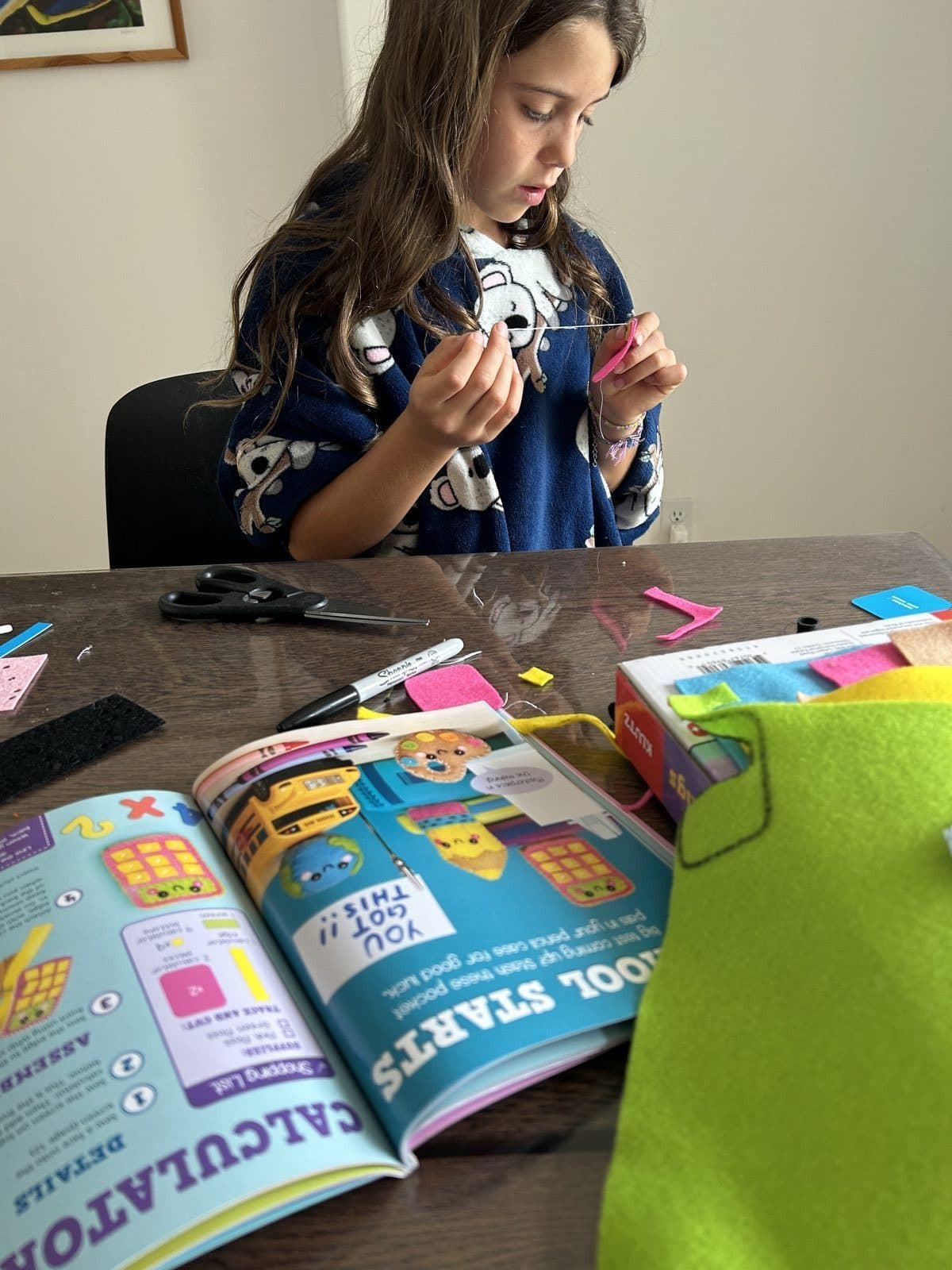
Longer sessions (30 to 45 minutes), more independence, and the start of being able to own a personal project for days or weeks. This is the sweet spot for hands-on, real-world learning. Kids this age can manage a small budget, plan and cook a meal, run a tiny business, or take ownership of a long build. (What kids should know before 18 covers the bigger arc.)
Ages 12 to 14
This is where ownership of the schedule itself starts to shift toward the kid. A 13-year-old should be planning a meaningful piece of their own week, not having every minute scheduled for them. Give them a list of what needs to happen across the week and let them decide when. This is also the age where time management becomes a real, teachable skill. (Time management for kids covers how.)
Common mistakes new homeschoolers make with schedules
- Recreating school at home. The desk, the bell, the timed subject blocks. By Wednesday, everyone is miserable. You did not leave school to build another one.
- Overscheduling year one. New homeschoolers often pack the day to prove (to themselves, to family, to the internet) that real learning is happening. Almost always works against them.
- Refusing to bend. Rigid schedules in a flexible-by-design lifestyle creates the worst of both worlds. The whole point of homeschooling is being able to follow what works.
- Not protecting parent time. A homeschool schedule that leaves zero space for the parent to think, work, or breathe is not sustainable. Build in your time on purpose.
- Quitting the schedule after one bad day. One bad day is data, not a verdict. Three bad weeks in a row is data. Give a new rhythm at least two weeks before judging it.
When to change your schedule
Schedules are not forever. Most families change theirs at least twice a year. Watch for these signals that yours has stopped working.
- Kids are melting down at the same time of day, every day. That block is too long, too hard, or in the wrong slot.
- You dread starting the morning. The schedule is asking too much of you. Cut something.
- Learning has stopped feeling alive. Likely the schedule has become more important than what is supposed to happen inside it.
- A season is changing. Summer needs a different shape than winter. A new baby, a move, a job change:all of these justify a new rhythm.
- A kid has aged into a new stage. The schedule that fit your 9-year-old will start to chafe your 11-year-old. Update it.
The bottom line
A homeschool schedule is not a school schedule with less travel. It is a fundamentally different shape, built around the way kids actually learn at home: fewer hours, deeper work, more real life, more rest, and more ownership over time as they grow. Pick the schedule from the spectrum that fits your family, give it two weeks, adjust one thing at a time, and trust that the right rhythm will emerge. There is no Pinterest-perfect homeschool day. There is only the one that works for the people inside it.
Want more real-world ways to learn through doing? Our free guide gives you a week of activities your kids can try, no curriculum, low prep.