- 1What critical thinking actually is
- 2Why it matters more now than it ever has
- 3The three questions to practice every day
- 4What critical thinking looks like by age
- 58 activities that build critical thinking
- 6What gets in the way
- 7Critical thinking in a world with AI
- 8The long game
- 9Frequently asked questions
If your kid has not asked an AI to write something for them yet, they will. And when that answer comes back polished, confident, and maybe not entirely accurate, the question is whether your kid can tell the difference. That is the whole game now.
Critical thinking is no longer a nice-to-have. It is the actual core skill. Not because AI is bad, but because AI is convincing. And a kid who cannot tell the difference between something that sounds true and something that is true is going to have a very hard time in the world that is coming.
This is not a post about being anti-technology. We use AI in our house. Our older kid uses it for his business. But using a tool and being used by a tool are different things, and the line between them is critical thinking. This post is part of our larger guide on life skills for kids, because critical thinking is the skill that makes all the other ones work.
What critical thinking actually is
Critical thinking gets used as a buzzword so often that it has stopped meaning anything specific. Schools say they teach it. Curriculum companies say they build it. Most of the time what they mean is "answering questions about a text," which is not the same thing at all.
Here is what critical thinking actually is. It is the ability to:
- Notice when something does not add up, even when it sounds confident
- Ask where information came from and whether the source has a reason to spin it
- Hold two possible explanations in mind at the same time and weigh them
- Change your mind when better evidence shows up, without feeling like you lost
- Separate what you want to be true from what the evidence actually supports
Notice what is not on that list. Speed. Getting the right answer. Being the smartest person in the room. Critical thinking is slow, uncomfortable, and often inconvenient. It is the kid who says "wait, that does not make sense" when everyone else has already moved on. It is the kid who asks "how do you know?" when a friend states something as fact. It is not a talent. It is a habit.
It overlaps heavily with decision-making, which is essentially critical thinking applied to choices. And it is the foundation of media literacy, which is critical thinking applied to information. If you have read those posts, think of this one as the root system underneath both.
Why it matters more now than it ever has
Every generation thinks the world is changing faster than the one before. But something genuinely new happened in the last two years. AI got good enough to sound like a human, and it became free and available to everyone, including kids.
That changes the equation. Before AI, a kid who could not think critically would still bump into friction: bad sources were often obviously bad, wrong answers were obviously wrong, and the gap between "I looked it up" and "I understand it" was visible. Now that gap is invisible. A kid can ask an AI to explain photosynthesis, get a clear and confident paragraph back, repeat it in class, and have no idea whether it is accurate, incomplete, or subtly wrong. The answer sounds right. That used to be enough. It is not anymore.
But AI is only one piece of the picture. Kids today are also navigating:
- Social media algorithms that show them content designed to confirm what they already believe
- Influencers who present opinions as facts, and products as solutions
- Peers who share information without checking it, creating echo chambers that feel like consensus
- A pace of information so fast that there is no natural pause to think before reacting
The antidote to all of this is the same skill: the ability to slow down and ask, "Is this actually true? How do I know? What am I not seeing?" That is not something you can teach in a lesson. It is something you build through years of practice, starting when kids are young enough to think it is a game.
The three questions to practice every day
You do not need a curriculum for this. You need three questions, used consistently, in ordinary moments. We started doing this about a year ago and the shift was slow but real. Our kids now ask these questions on their own, unprompted, which is the whole point.
Question 1: How do you know?
This is the foundation. Whenever your kid states something as a fact, gently ask: "How do you know?" Not in a gotcha way. In a genuinely curious way. "That is interesting, how do you know that?" It forces them to trace a claim back to its source. Most of the time the answer is "someone told me" or "I saw it on a video," and that is the perfect opening to talk about what makes a source trustworthy.
Question 2: Could it be wrong?
This one is harder because kids (and adults) do not love sitting with uncertainty. But it is the muscle that matters most. "You might be right. But could it also be wrong? What would that look like?" This teaches a kid that confidence and correctness are not the same thing. A person can sound very sure and still be mistaken. An AI can write a beautiful paragraph that is factually wrong. Could it be wrong? is the question that catches this.
Question 3: Who benefits if you believe it?
This one is for kids around age 9 and up, when they start to understand persuasion. Every piece of information exists in a context. Ads want you to buy something. Influencers want you to follow them. Politicians want your vote. Even friends sometimes share information because it makes them feel important, not because it is accurate. "Who benefits if you believe this?" is the question that teaches kids to look for the motive behind the message. It is not cynicism. It is awareness.
The key is tone. These questions work when they come from genuine curiosity, not from a quizzing posture. If your kid feels tested, they will shut down. Ask the way you would ask a friend: casually, with real interest. And answer the questions about your own beliefs too. "I read this article that said X. But I am not sure, because the source was trying to sell something. Let me check." Model the thinking out loud. That is what sticks.
Critical thinking is not about being right. It is about being willing to find out you are wrong.
What critical thinking looks like by age
The skill develops in layers. A six-year-old and a twelve-year-old are both capable of critical thinking, but the complexity of what they can hold in their minds is very different. Here is what to aim for at each stage.
Ages 6 to 8: noticing and questioning
At this age, critical thinking looks like noticing things that do not match and being willing to say so. Young kids are actually natural critical thinkers because they have not yet learned to accept things just because an adult said them. Your job is to protect that instinct, not to train it in from scratch.
- They can notice when a story does not make sense ("But how could the bear talk if bears do not talk?")
- They can compare two explanations and say which one they think is more likely
- They can sort things into "I know for sure" and "I think so but I am not sure"
- They can start to tell the difference between a fact and an opinion if you point it out
Activities at this age should feel like play. Spot the mistake in a story. Find the thing that does not belong. Play "true or silly" where you make statements and they sort them. Read a book and ask, "Do you think the character made a good choice? Why?"
Ages 9 to 11: evaluating and comparing
This is the age where kids start to understand that people can look at the same situation and reach different conclusions, and that does not mean one of them is lying. They can hold complexity. They can start to evaluate sources. They can argue a position and then argue the opposite one.
- They can ask "where did this information come from?" and understand why it matters
- They can spot when an ad is trying to make them feel something to sell them something
- They can argue both sides of a simple debate and notice which arguments are stronger
- They can read two different accounts of the same event and notice what is different
- They can start to separate "I want this to be true" from "the evidence says this is true"
Activities at this age can be more structured. Play "spot the persuasion" with ads, packaging, and YouTube thumbnails. Read two news articles about the same event and compare. Have a family debate night where someone argues the opposite of what they actually believe. Watch a documentary and pause halfway to ask, "What do you think they are not showing us?"
Ages 12 to 14: reasoning and self-correcting
By this age, a kid with practice can do something most adults struggle with: change their mind based on evidence, without feeling like they lost. That is the peak of critical thinking, and it is rare. Most adults dig in when challenged. A 13-year-old who can say "I thought X but now I think Y because of this" is doing something genuinely impressive.
- They can evaluate whether a source is credible (not just whether it sounds confident)
- They can identify logical fallacies in arguments, even when they agree with the conclusion
- They can recognize their own biases and name them
- They can engage with AI output critically, checking claims instead of copying them
- They can hold a strong opinion and still be open to revising it
Activities at this age should be real. Have them fact-check an AI-generated paragraph. Give them a real family decision and let them research the options and present a recommendation. Ask them to find the weakest argument in something they agree with. Let them evaluate a product or service the family is considering, research reviews, compare prices, and check whether the marketing claims hold up. This is critical thinking applied to real life, and it is the version that sticks.
8 activities that build critical thinking
These are not worksheets. They are things you do with your kid in ordinary life that practice the thinking habits. Do them together. The conversation is the point.
1. Fact-check dinner conversation
When someone at the table states something as fact, anyone can call "source check." No penalty, no gotcha. Just a pause to ask where the information came from. If nobody knows, someone looks it up. This becomes a family culture fast, and kids start doing it with friends too.
2. Spot the persuasion
Walk through a grocery store or scroll through ads together and ask: "What does this want you to feel? What does it want you to do? How is it trying to get you there?" Kids get shockingly good at this. Packaging, YouTube thumbnails, app notifications. Once they see the pattern they cannot unsee it.
3. Two-source rule
Anytime your kid tells you something they learned online, ask them to find one more source that says the same thing. If they cannot, that does not mean it is wrong. It means they do not know yet. The habit of checking is the point.
4. Argue the other side
Pick a topic your kid has a strong opinion about (bedtime, screen rules, whether cats are better than dogs) and ask them to argue the opposite position for two minutes. This is uncomfortable and powerful. It builds the ability to understand a perspective without agreeing with it, which is one of the rarest and most valuable thinking skills.
5. AI fact-check challenge
Ask an AI a question your kid is curious about. Read the answer together. Then check three of the specific claims using other sources. How many were accurate? How many were partly true but missing context? How many were just wrong? This is not anti-AI. This is teaching your kid to use a powerful tool responsibly, the same way you teach them to use a kitchen knife.
6. What is missing from this story?
After reading a news article, watching a video, or hearing about an event, ask: "What do you think we are not being told?" Not in a conspiracy way. In a "every story is told from a perspective and that perspective leaves some things out" way. This builds the habit of looking for what is absent, not just reacting to what is present.
7. Real-world decision research
Give your kid a real decision the family is making: which campsite to book, which phone plan to switch to, whether to buy or rent something. Let them research it, compare options, and present their recommendation with reasons. Then follow through on their recommendation if it is reasonable. The stakes make the thinking real.
8. "I changed my mind" moments
Whenever you change your mind about something, say it out loud and explain why. "I used to think X but I read this and now I think Y." Whenever your kid changes their mind, celebrate it. "That is really good thinking. It is hard to change your mind and you did it because the evidence was better." Make mind-changing a sign of strength, not weakness. That reframe changes everything.
In the Membership
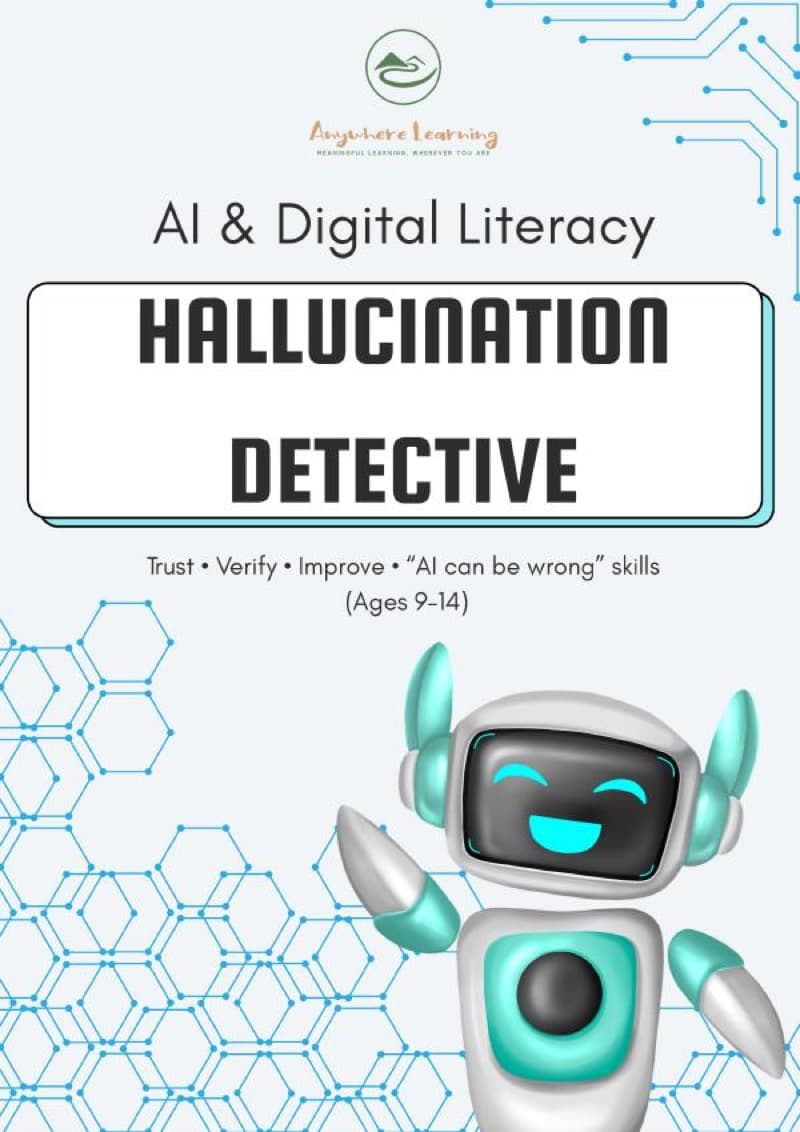
Hallucination Detective
If your kid uses AI already, this activity teaches them to spot when it gets things wrong.
What gets in the way
A few patterns that accidentally shut down critical thinking in kids, even when parents are trying to encourage it.
- Rewarding the right answer instead of the thinking process. If a kid gets praised only when they are correct, they learn that being wrong is bad. Critical thinking requires being wrong regularly and learning from it.
- Shutting down questions that are inconvenient. "Because I said so" is sometimes necessary for safety. But if it is the default response to every "why?", a kid learns that questioning authority is not welcome.
- Correcting too fast. When a kid says something wrong, the instinct is to fix it immediately. But the most powerful learning happens when you ask a follow-up question instead: "Interesting. What makes you think that?" Let them discover the error through their own reasoning.
- Modeling certainty you do not have. If you always sound sure, your kid will think that confidence equals correctness. Show them what honest uncertainty looks like.
Critical thinking in a world with AI
This is the part that most parents are not thinking about yet, but should be. AI is not going away. Your kid is going to use it for schoolwork, for their job, for personal decisions. The question is not whether they use it. The question is whether they can evaluate what it gives them.
Right now, most kids (and most adults) treat AI output the way they treat a textbook: if it is written clearly and confidently, it must be correct. But AI hallucinates. It makes things up with the same tone it uses for things it gets right. There is no font change, no disclaimer, no red flag. The only way to catch it is to already know enough to be skeptical. That is critical thinking.
The kids who will thrive are not the ones who avoid AI. They are the ones who use it as a starting point and then verify, question, and refine. That is the same skill as reading a news article critically, or listening to a friend is claim and checking it, or watching an ad and seeing the persuasion. The technology is new. The skill is ancient. We go deeper into this in our AI and digital literacy guide.
In the Membership
What Would You Do? Decision Lab
Critical thinking applied to real choices. Your kid weighs options, considers consequences, and defends their decision.
The long game
Critical thinking does not show up overnight. It builds the way any habit builds: through repetition, modeling, and a family culture where questioning is safe and changing your mind is respected. You will not see a switch flip. You will see small moments. Your kid pausing before sharing something. Your kid saying "I do not think that is true" to a friend. Your kid asking you where you heard something. Those moments are the evidence.
And it starts with you. Kids do not learn critical thinking from a lesson. They learn it from watching the adults in their life think out loud, admit uncertainty, change positions, and take information seriously enough to check it. If you do that, consistently, the rest follows.
Want the age-by-age version? The Capable Kid Guide lays out what kids can actually do from 6 to 14, and how to hand each skill over. Free, from a former teacher.
Critical thinking is the skill underneath every other skill on the life skills for kids list. Without it, resilience is just stubbornness. Without it, decision-making is just guessing. Without it, emotional regulation has no framework to hang on. It is the one skill that makes all the others actually work.
And it costs nothing to start. Tonight at dinner, when someone says something as fact, ask: "How do you know?" Say it with a smile. Say it with real curiosity. Do it every day for a month. You will not recognize the conversations your family is having by the end of it.
If you want these kinds of thinking skills built into structured, ready-to-use activities for ages 6 to 14, that is exactly what the Anywhere Learning membership is for. No curriculum, no worksheets. Just real-world activities that build the skills that matter, done together. But the three questions at dinner? Those are free, and they work.