My daughter came home from a playdate last month and told me that a certain brand of slime was “the best in the world” because her friend’s favourite YouTuber said so. When I asked how the YouTuber knew it was the best, she paused. “Because she tried them all?” she offered, not quite sure anymore.
That’s a media literacy moment. Not a lecture moment, a conversation moment. We talked about how the YouTuber might have been paid to say that, and how “best” is an opinion, not a fact. She wasn’t upset. She was genuinely interested. “So how do I know what’s actually good?” she asked. And honestly, that question is the entire foundation of media literacy.
If your child can learn to pause before believing, to ask “who made this and why?” and to distinguish between information and persuasion; they’re going to navigate the digital world far better than most adults do right now.
Why media literacy matters more now than ever
Every generation has had to deal with media manipulation, propaganda, advertising, biased reporting. But this generation faces something new: the sheer volume of content, the sophistication of targeting, and the rise of AI-generated material that can look and sound completely real.
Your kids are seeing AI-generated images, deepfake videos, algorithmically curated news feeds, sponsored content disguised as genuine recommendations, and influencer posts that blur the line between friendship and advertising. All of this before they’ve developed the cognitive tools to evaluate it.
That’s not a reason to panic. It’s a reason to start building those tools now.
What media literacy actually means
Media literacy isn’t just about spotting fake news. It’s a broader set of skills that includes:
- Identifying who created a piece of content and why
- Recognising persuasion techniques (emotional appeals, urgency, social proof)
- Distinguishing between fact, opinion, and advertising
- Understanding that algorithms curate what you see (and what you don’t see)
- Evaluating whether a source is reliable, biased, or fabricated
- Recognising AI-generated content (images, text, video)
When you break it down like this, it’s clear that media literacy is really just critical thinking applied to the content your child encounters every day. And critical thinking is something we can practise at any age.
Age-appropriate media literacy skills
Ages 5–7: Ads vs. shows
Start with the most basic distinction: some content is trying to sell you something, and some isn’t. Watch TV together and play “spot the ad.” Point out when a character in a show is using a branded product. Ask: “Do you think they chose that drink because they like it, or because someone paid for it to be there?”
At this age, the goal isn’t deep analysis. It’s planting the seed of “not everything I see is what it seems.”
Ages 8–10: Source checking and opinion vs. fact
This is the age where kids start using the internet for research, and they need to know that not all websites are equal. Teach the basics: who wrote this? What’s their expertise? Is this a news site, a blog, a company page, or something else? Does this source cite where it got its information?
Also work on opinion vs. fact. “Chocolate is delicious” is an opinion. “Chocolate contains caffeine” is a fact. “Chocolate is the best dessert” is an opinion disguised as a fact. Kids this age love catching these once they know to look for them.
Ages 11–13: Algorithms, manipulation, and AI content
Older kids are ready to understand that the content they see online isn’t random; it’s chosen by algorithms designed to keep them watching. Talk about filter bubbles, echo chambers, and why their feed shows them more of what they’ve already clicked on. This is also the age to explore AI-generated content and how to spot the myths around it.
In the Membership
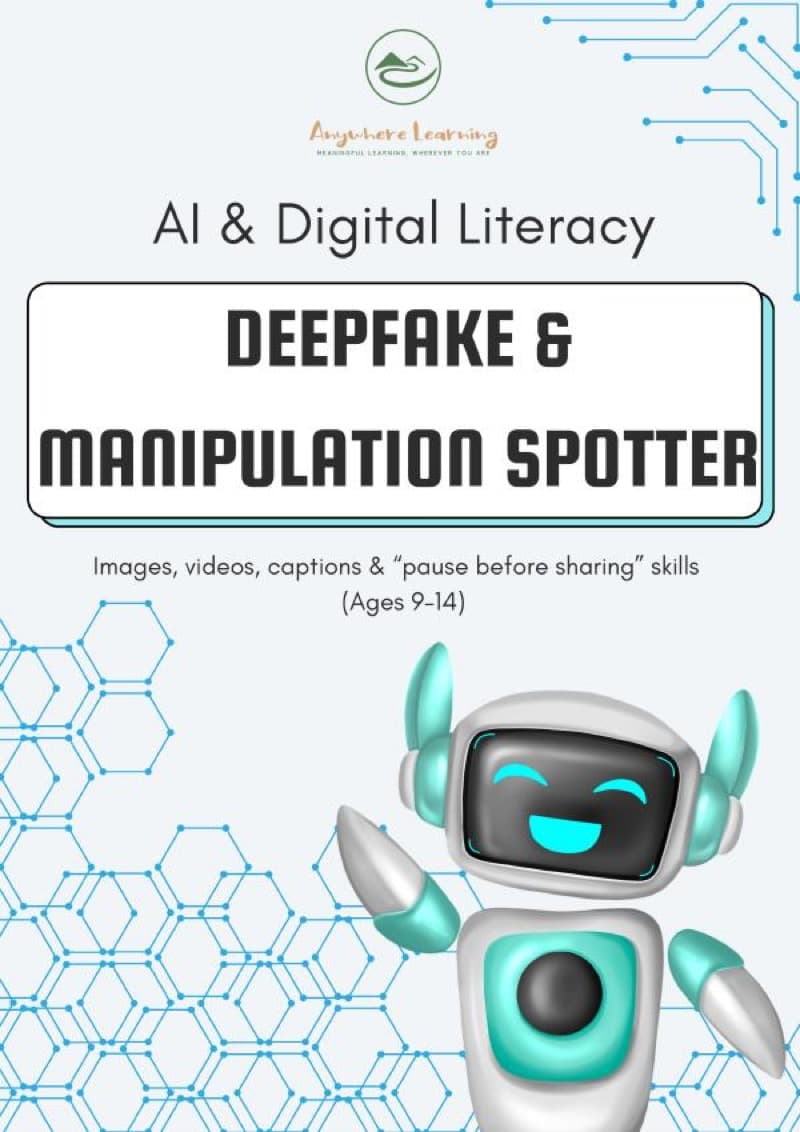
Deepfake & Manipulation Spotter
Media literacy for kids ages 9-14: spot deepfakes and manipulated content. Essential digital literacy for the AI age.
Practical activities you can do this week
Reverse image search
Find a dramatic-looking image online and show it to your child. Then do a reverse image search together (right-click, “Search image with Google”). You’ll often find the same image used with completely different captions and stories. This is a powerful, visceral lesson in how images can be taken out of context.
The source trail
Pick a claim your child has heard, from a friend, a video, or social media, and trace it back to its source together. Where did this information start? Who said it first? Is there evidence? Often the trail dead-ends at “someone on the internet said it,” and that’s a valuable finding in itself.
Ad analysis
Watch a few commercials or look at social media ads together. For each one, ask: What are they selling? What feeling are they trying to create? What are they NOT telling you? Would you still want this if a friend recommended it vs. a paid ad? My kids have gotten scarily good at this; they’ll point out marketing tactics in the wild now, which honestly makes shopping trips more entertaining.
The AI detection game
Show your child a mix of real photos and AI-generated images. Can they tell the difference? Look for the telltale signs: weird hands, inconsistent backgrounds, text that doesn’t quite make sense, overly smooth skin. As AI gets better, this game gets harder, which is exactly why it’s important to practise.
The AI-generated content challenge
This deserves its own section because it’s changing so fast. AI can now generate text, images, audio, and video that are increasingly hard to distinguish from human-made content. Your kids will encounter AI-generated articles, social media posts, product reviews, and even “news” stories that look completely legitimate.
The old advice of “check if it looks professional” doesn’t work anymore, because AI-generated content often looks very professional. Instead, teach kids to check the source, not the surface. Who published this? Can you find this information from multiple independent sources? Does the author exist? Is there a track record of reliability?
We’re not raising kids to be suspicious of everything. We’re raising them to be thoughtful about what they trust, and that’s a very different thing.
Building healthy scepticism (not cynicism)
There’s a fine line between critical thinking and cynicism, and it’s important to stay on the right side of it. The goal isn’t to make your child distrust everything. It’s to give them the skills to evaluate what they encounter and make informed judgments.
A sceptic says: “Let me check that before I believe it.” A cynic says: “Nothing is true and everyone is lying.” The first is empowering. The second is paralysing. Emphasise that reliable sources do exist, that good journalism is real, and that most people aren’t trying to deceive them. But some are, and knowing the difference is a superpower.
In our family, we’ve framed it positively: being a good thinker means you get to decide what’s worth your attention. That feels powerful to a kid, not restricting.
Want this as a free printable? Grab the 18 AI & Digital Literacy Ideas for Kids, free to read, and the printable version lands in your inbox.
Before your child believes or shares any interesting claim, have them check it against three independent sources. If three unrelated, reliable sources agree, it’s probably solid. If they can only find it on one website or social media post, it’s worth questioning. This simple habit prevents most misinformation from taking root.