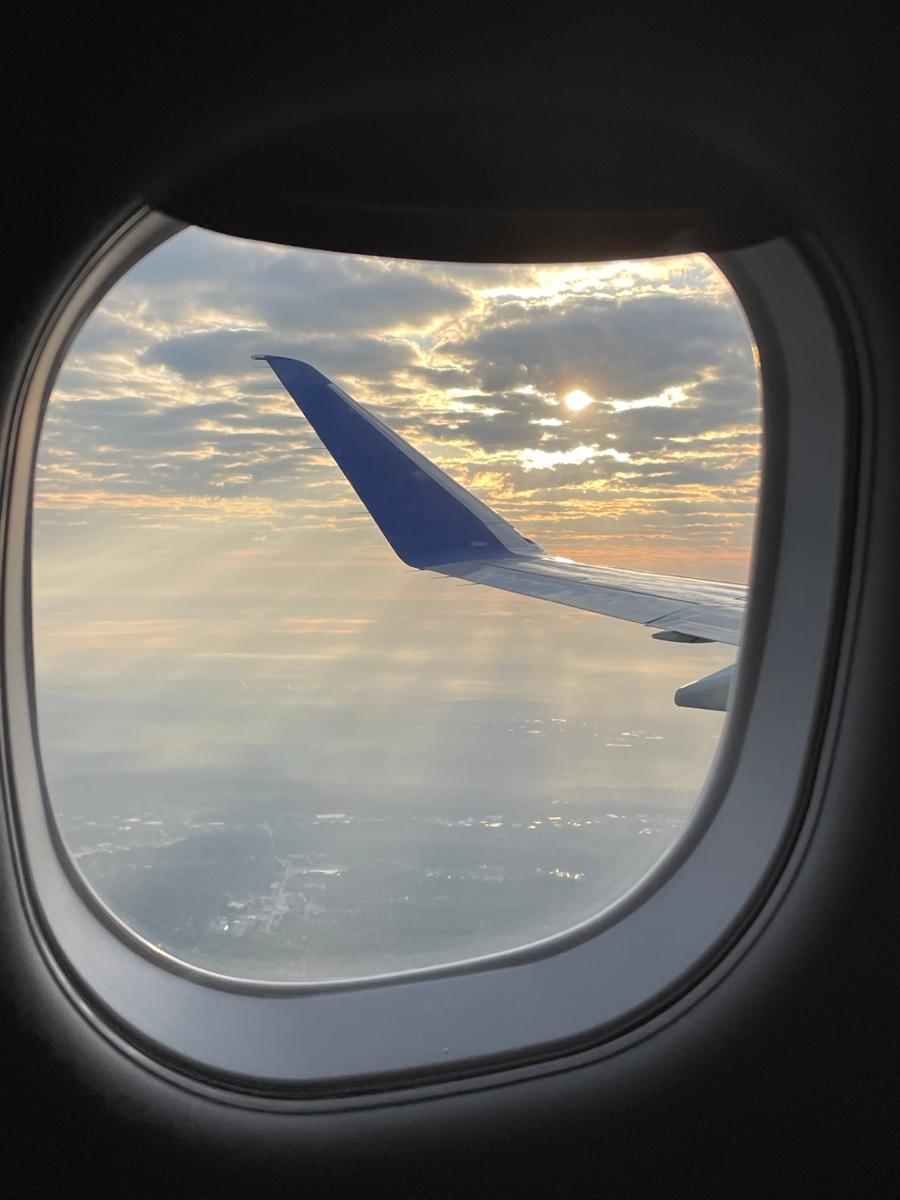
When a driver asks us a question, in an Uber, a shuttle or a tuk tuk, it is usually my kids who answer. Their dad can’t understand much Spanish, so they talk for him.
Spanish is their third language. French is our home language, and English is everywhere else: sports, friends, the whole community. Switching between those two is just who they are. Spanish is harder. My son is 13 and my daughter is 10, and between last winter in Panama, Costa Rica and El Salvador and this fall in Guatemala, they have come a long way.
Here is what made the difference over two winters of worldschooling, and how to use it on the road or at home.
Language lessons abroad: one-on-one does the most
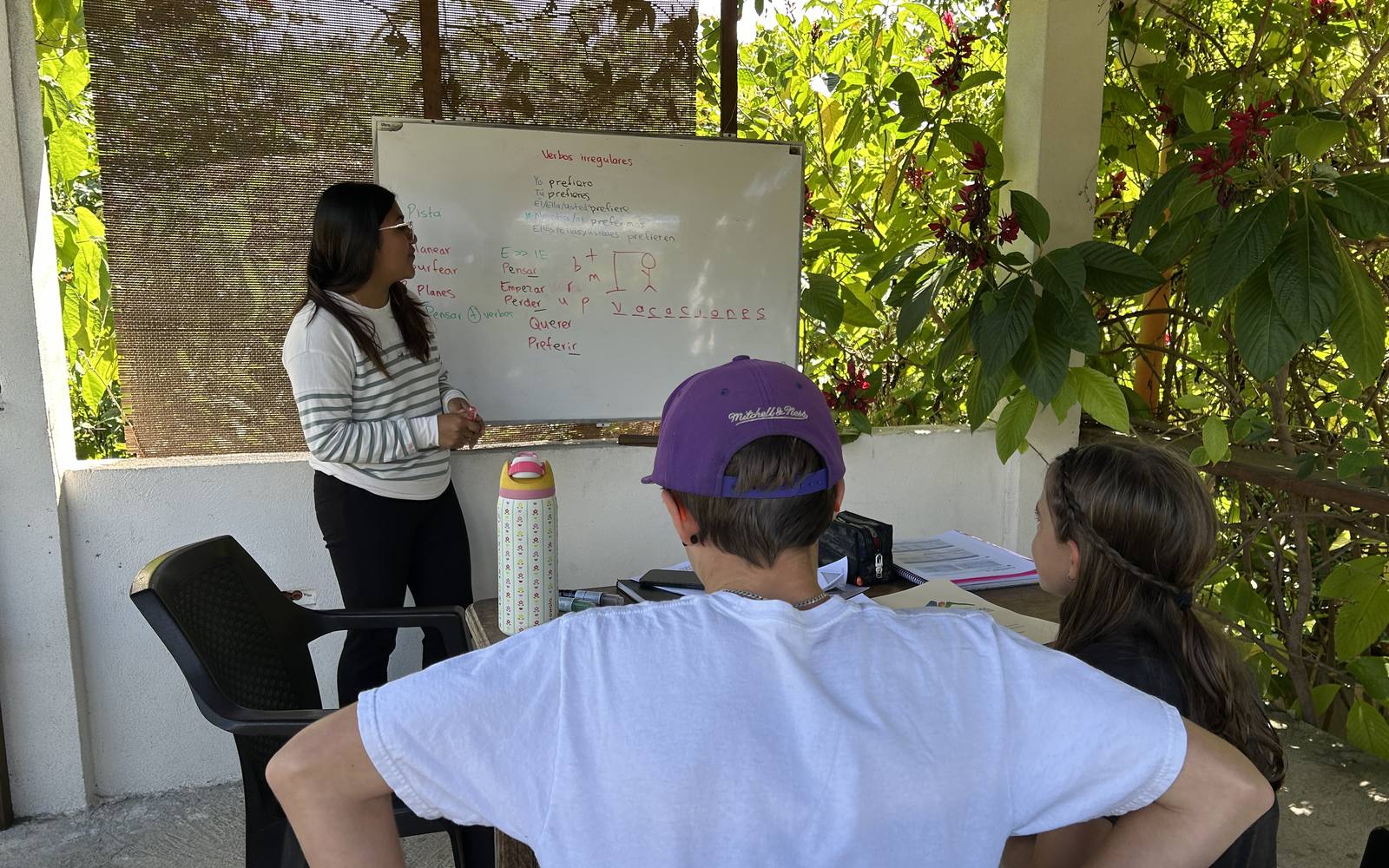
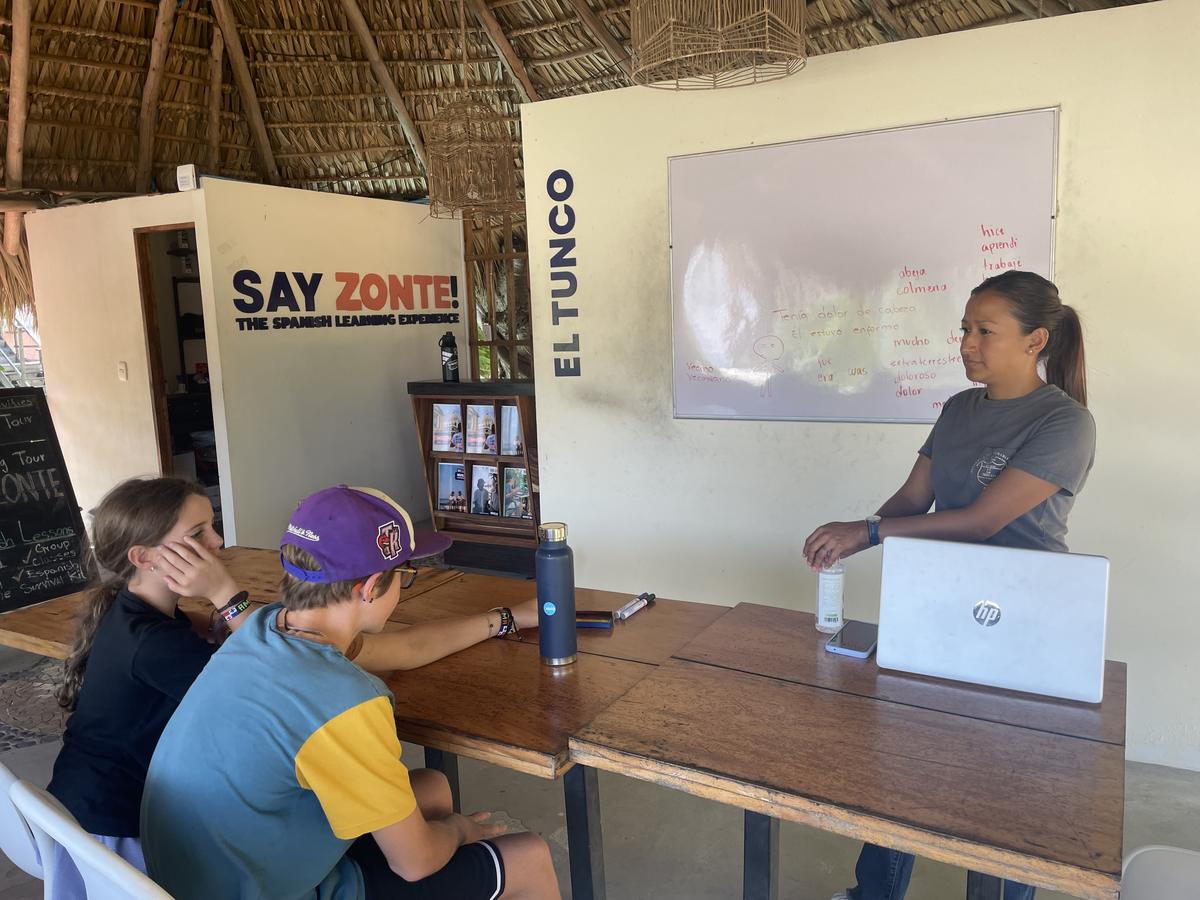
We have tried a few setups, and for the language itself, one-on-one lessons have done the most for our kids. In El Salvador, we had a private teacher through a school: one hour every day for two weeks, the kids and me together, working on grammar and conversation. In Guatemala, they go to a Spanish school every weekday from 1 to 4 pm, the two of them with one teacher. Mornings are for everything else: math, art, sports and projects. (Here is how we structure a worldschool day in general.)
A teacher who is only working with your kids can go at their pace, catch their mistakes and push them to speak instead of just listen. The school here also organizes cultural activities and gives us great information on the region when we need it, which helps more than you would think in a new place.
Questions to ask a language school
- Do they teach kids, and what ages? Some schools are set up mostly for adults.
- Will your kids be together or separate, and how many students per teacher?
- How many hours a day, and at what time? Afternoon classes leave your mornings for other things.
- How much is grammar and how much is conversation?
- Do they organize cultural activities, and can they help with information about the region?
- Can your kids try one class before you commit to a week?
When a bilingual school makes sense
Last winter in Panama and Costa Rica, we registered the kids part time in a bilingual school. We knew it would not be mostly about Spanish, and that was the point: connecting with other kids, seeing the differences with what they know, learning things we might not learn at home, facing a new lifestyle and hearing new opinions. For a long stay, that is worth as much as the language.
A mission ladder: from first words to real conversations
Lessons give them the words. What makes the words stay is using them for something real, the same day, with a real person. Kids don’t go from zero to chatting with a stranger in one step, so think of it as a ladder. Start on the first rung, and move up when the last one feels easy.
- 1Greet and thank: hello, thank you, goodbye, every time, with everyone. It sounds small, and it is the rung that makes people warm up to them.
- 2Answer easy questions: what is your name, where are you from. Our kids’ very first time was in an Uber in Panama, giving the driver the ride’s identification number and then answering his questions.
- 3Buy something on their own: the next step for ours was walking to the tienda, the little corner store, to buy food. Prices are numbers, so this is where the math comes in.
- 4Talk for someone else: the whole family’s order, or the questions a driver asks when the parent doesn’t speak the language. This is where our kids help their dad, mostly in Ubers, shuttles and tuk tuks.
- 5Ask something they don’t know the answer to: directions, information, what someone recommends. Now they have to understand the reply, which is the hard part.
- 6Build a connection: the same shopkeeper, teammate or neighbour, again and again. In Santa Catalina, my daughter became friends with the cashier at the tienda. They had a short conversation every time she went in, and when we left, she made her a goodbye note.
That last rung is the one that matters most. The day a kid wants to talk to someone, not just get something from them, the language stops being a subject. It helps that people in Central America have been so open about it: most are genuinely happy to speak Spanish with visitors who are trying.
Your role while they do the talking
Stand close, a little behind them, and let them lead. Count to five in your head before you step in. Most of the time they find the word, or the other person helps them out. If they are really stuck, whisper one word, not the whole sentence. Afterwards, ask what worked and which word they were missing. That word goes on tomorrow’s list.
The hard parts (and what helps)
Masculine and feminine
For our kids, the hardest part is masculine and feminine words, with all their exceptions. Coming from French makes it trickier, not easier, because the genders don’t always match: milk is la leche in Spanish but le lait in French, and the sea is el mar but la mer. What helps is learning every new word with its article, el or la, from the start, and keeping a short list of the ones that trip them up.
Fast talk and slang on the field
My daughter plays soccer here and my son plays basketball, and that has been harder than class. People talk faster than in a lesson and use more slang and expressions. What our kids do is look around and see what the others are doing, and follow along until the words catch up. A team is still worth it: it gives them kids their own age and a reason to speak that has nothing to do with school.
In the Membership
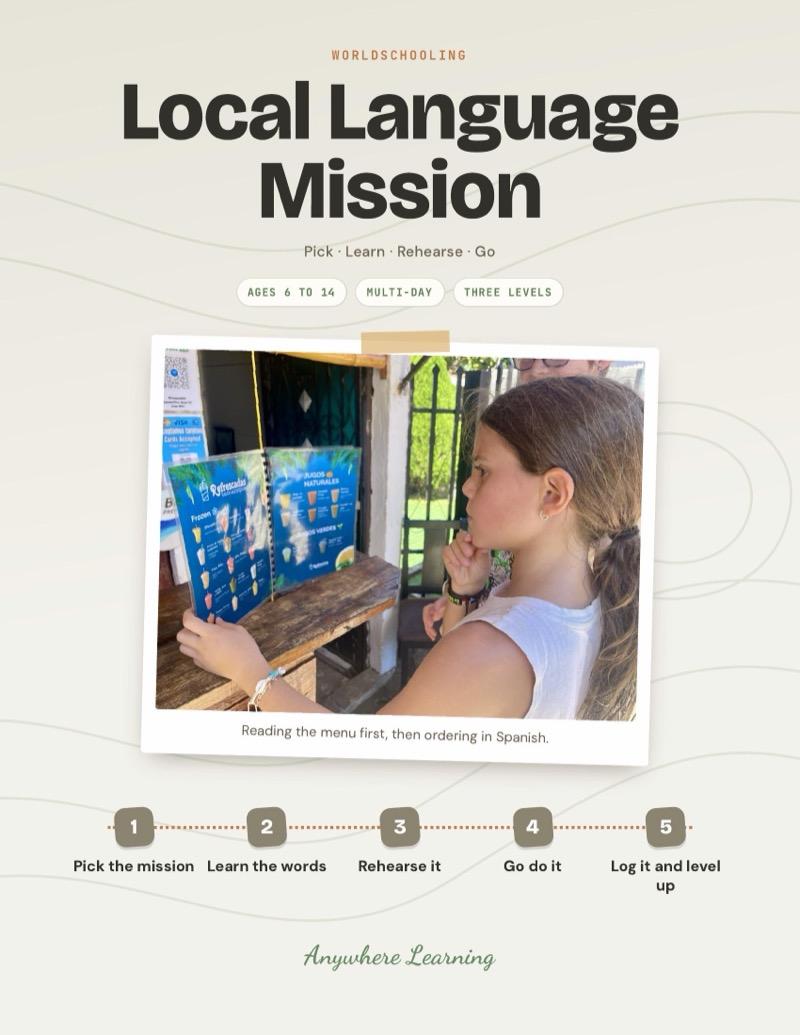
Local Language Mission
Local Language Mission turns one rung into a real job: your kid picks a mission, like buying fruit or ordering a snack, learns only the words it needs, rehearses with you as the shopkeeper, then does it for real.
Culture, math and writing come with it
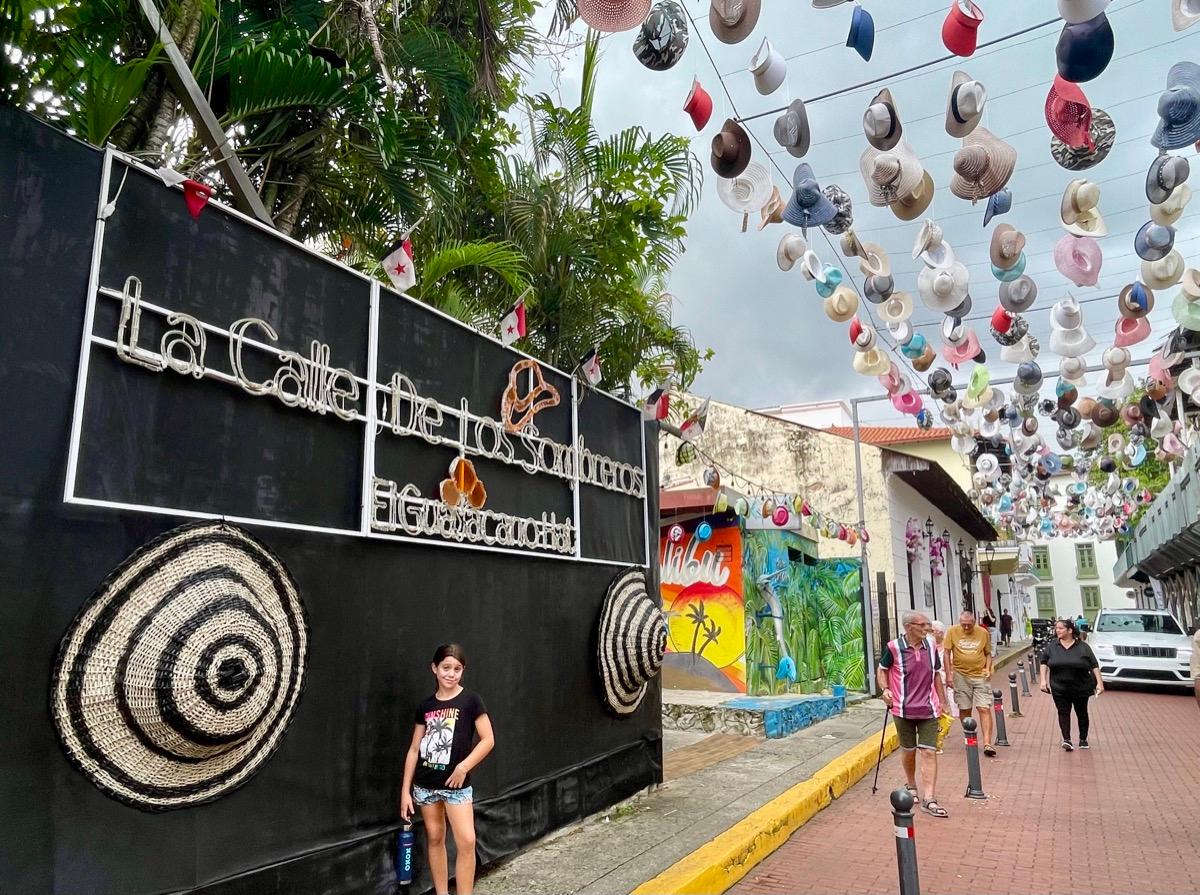
A language makes more sense when you know the place it comes from. Alongside the lessons, we look for activities where the kids learn how people live: cooking classes (pupusas in El Salvador, tamales in Guatemala), making bracelets in Guatemala, a coffee tour and a chocolate tour in Panama. Each one comes with new words and a real reason to ask questions. A cooking class is a vocabulary lesson you get to eat at the end.
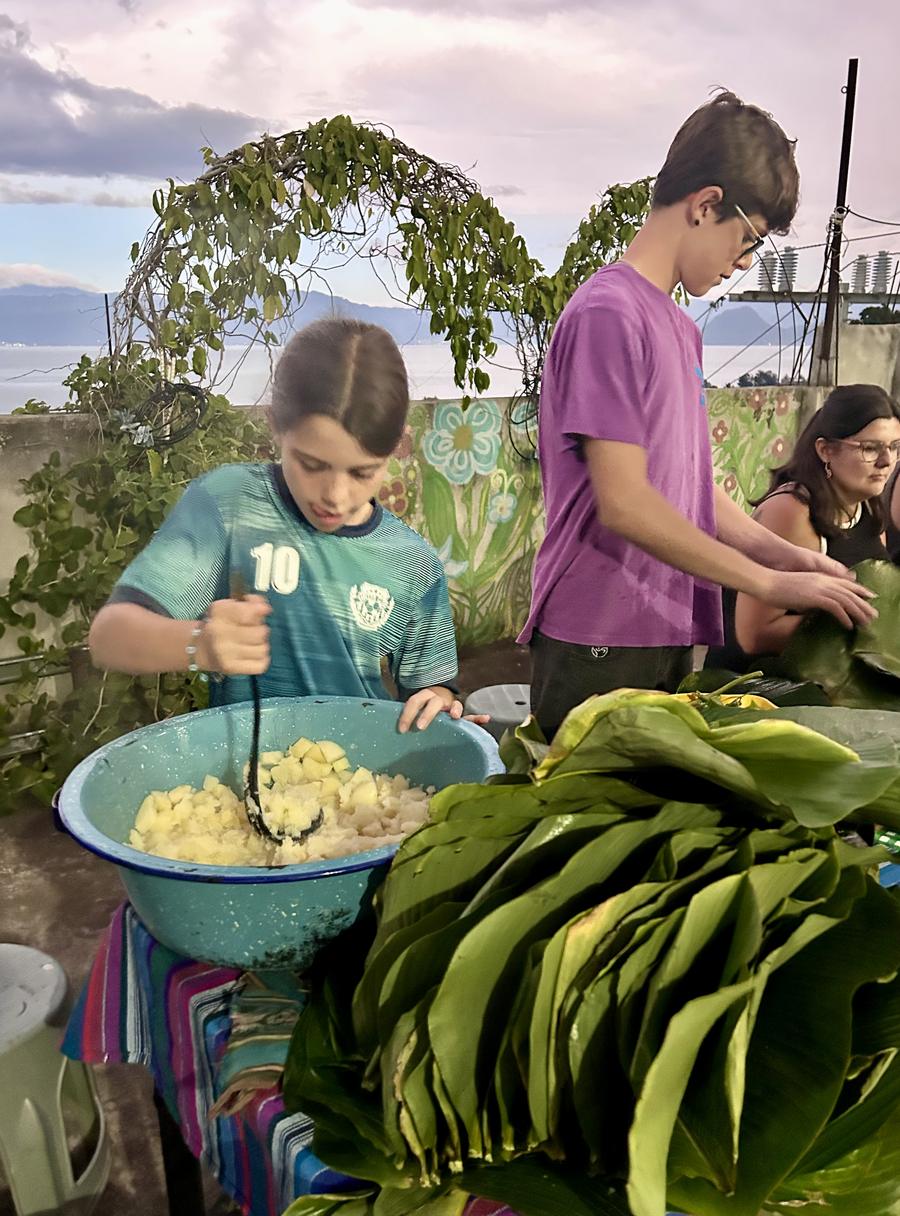
It is not only a language lesson either. A new currency means real-world math at every stall: what does this cost, is that a good price, how much change should come back? Older kids can convert prices back to the money they know and compare two stores before they buy. Writing fits in too. A small notebook of the words they needed that day becomes their own dictionary. At the end of every trip, my kids write a review of the country, scored out of 100 (the same idea as My Review Column). Writing part of it in the language of that country is a great stretch for an older kid.
What it looks like by age
Ages 6 to 8
Stay on the first three rungs, with you right beside them. Songs, counting games and greeting everyone you pass do a lot of the work. Their first real win is usually saying thank you and getting a smile back.
Ages 9 to 11
They can buy something on their own while you watch from a few steps away: ask the price, pay, count the change. This is a great age for a regular shopkeeper they get to know. Start the word notebook.
Ages 12 to 14
Hand them the harder rungs: talking for the family, asking for information, keeping up with teammates. This is the age for real one-on-one lessons and a few lines of writing a day in the new language.
At home, and before a trip
When we are not traveling, the kids use Duolingo every day. They do the daily quests, sometimes more. It keeps the words fresh between trips. It does not replace talking to a real person, but it means they don’t start from zero when we land.
You don’t need a trip to use the ladder. Most towns have a restaurant, a shop or a market run by people who speak the language. A neighbour, a grandparent or a family friend can be the person on the other side of the counter. Learn the words for one small job, practice it at home, then go do it for real.
- Order one thing at a restaurant in the language, after practicing the order at home.
- Ask a shopkeeper one question: the price, or where something is.
- Cook one dish from a place where the language is spoken, reading the recipe in it.
- Call or video-call someone who speaks it and ask them three questions.
If a trip is coming, start a few weeks before you leave (our homeschooling while traveling post covers the rest of the prep): a little app practice every day, the numbers up to 100 (prices are the first thing they will need), and the first three rungs rehearsed at home with you playing the driver or the shopkeeper.
What to expect
A few weeks in a country will not make your kids fluent. Over two winters, ours have learned a lot more words and can build much longer sentences, and they still mix up their masculines and feminines. What the travel gives them most is confidence: they know they can be understood in a language they are still learning, and that people are kind when you try. That is what keeps them going.
Keep the lessons, keep the real-world practice, and let the small wins do the motivating. Answering a driver’s questions is a small win. A goodbye note for a cashier who became a friend is a big one.
Want this as a free printable? Grab the 22 Travel & Worldschool Activities for Kids, free to read, and the printable version lands in your inbox.
If you want missions like these ready to go, along with 120+ other real-world activities for ages 6 to 14, that is what the Anywhere Learning membership is for. Open a guide, follow the steps, and do it together, at home or on the road.