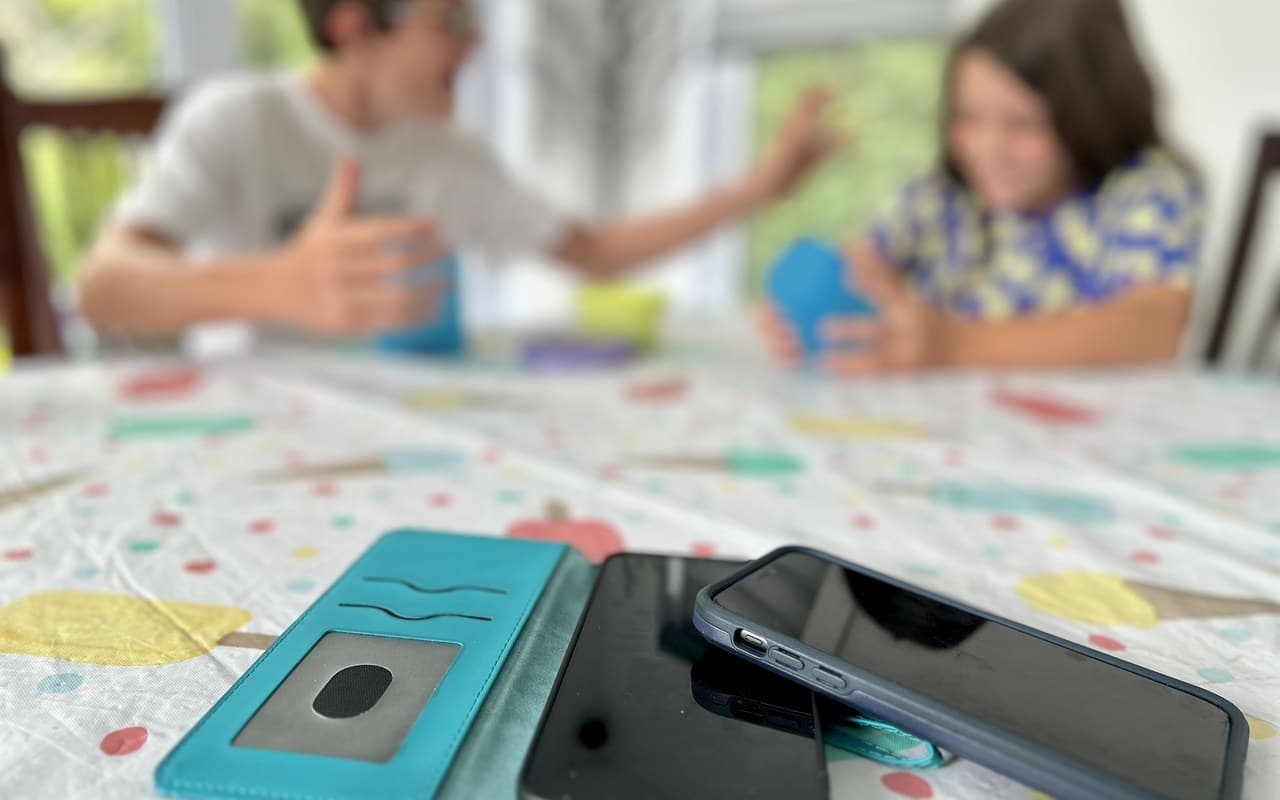
At some point, usually somewhere between fourth and sixth grade, your kid will come to you with a version of the same sentence: "Everyone in my class has a phone." It will feel like a fact, and it will feel like pressure, and you will feel the pull to just give in and get them one so they are not the odd one out.
And the pressure is real, not imagined. By the numbers, most kids have their own smartphone by age eleven or twelve, and roughly a quarter of eight-year-olds already do, according to Common Sense Media research. Meanwhile, most parents say kids should be at least twelve, which tells you how many families are giving in earlier than they think is ideal. Phones are arriving younger than a lot of parents realize. That does not mean yours has to.
Before you do, take a breath, because when should I give my child a phone is one of the more consequential questions you will face in these years, and "everyone has one" is not actually an answer. The real question is not what age kids should get a phone. It is whether your kid is ready for one, and how much phone they are ready for. Those are answerable questions, and this is a framework for answering them. Learning to handle technology wisely is one of the modern life skills every kid needs, and how you handle the first phone sets the tone for all of it.
Why "what age" is the wrong question
Parents desperately want a number, because a number is simple. Is it 10? 12? 14? But age is a terrible proxy for readiness. A mature, self-regulated eleven-year-old may handle a phone better than an impulsive fourteen-year-old. The calendar does not tell you what you actually need to know.
What matters is maturity and habits: can this specific kid handle the responsibility, the distraction, and the social pressure a phone brings? That is why "what age should a kid get a phone" leads people astray. Swap it for a better question: "is my kid ready, and ready for what?" A phone is not one thing. A basic call-and-text phone is a completely different decision than a smartphone with a browser and social media, and lumping them together is where a lot of parents go wrong.
So the honest answer has two halves that fit together. Wait as long as you reasonably can, because for most kids later is genuinely better. And when you eventually cannot wait any longer, make sure they are actually ready and give the least phone that meets the real need. Waiting is the default. Readiness is how you decide when the wait is finally over, not a reason to rush the day forward.
The cultural moment: later is winning
It used to feel like giving kids a smartphone younger and younger was inevitable. That has genuinely shifted. A growing movement of parents, schools, and researchers now argues that we handed kids powerful, addictive, internet-connected devices far too early, and that delaying, especially social media, is better for their attention, sleep, and mental health.
You have probably seen it: pledges like Wait Until 8th, where families agree together to hold off on smartphones until at least eighth grade, phone-free school policies, and a wave of books and research questioning the early-phone norm. You do not have to agree with every claim to notice the direction. The pressure used to be "everyone has one, so you should too." Increasingly, there is real, growing permission to wait, and community support for doing it. If you have been feeling like the last holdout, you are not. You are early to a trend that is turning.
The most influential voice in all of this is social psychologist Jonathan Haidt, whose bestselling book The Anxious Generation argues that handing kids smartphones and social media too early rewired childhood in genuinely harmful ways: less sleep, more anxiety, fractured attention, and years of real-world experience traded for a screen. He proposes four simple norms that a fast-growing number of families and schools are adopting: no smartphone before high school (around age fourteen), no social media before sixteen, phone-free schools, and far more free play and independence in the real world.
That last norm is the one we care about most, because it is the whole point. A childhood full of real-world play, boredom, responsibility, and face-to-face connection is not a consolation prize for kids who are waiting on a phone. It is the thing itself, and it is exactly what builds a kid who can eventually handle a phone well. The strongest case for waiting is not fear of the device. It is how much good stuff a delayed phone leaves room for. So if you are able to wait, and to spend those years raising a capable, grounded, well-loved kid, that is not depriving them. That is the gift. And none of this is a verdict on families who chose differently under real pressure. It is simply the case, made plainly, that waiting is a legitimate and increasingly well-supported choice.
The three readiness signals that actually matter
Forget the number. Child development experts increasingly stress maturity and readiness over a set age, and these three signals are a practical way to gauge it. They are the real signs your child is ready for a phone, and none of them have anything to do with their birthday. One caution, though: readiness is a floor, not a starting gun. Clearing these signals means a kid could handle a phone responsibly when a genuine need arises, not that you should hand one over the moment they qualify. The default is still to wait.
1. They can handle boredom without a screen
A phone is the ultimate boredom-eliminator, which is exactly the problem. A kid who cannot sit with a dull moment without reaching for stimulation is not ready to carry an infinite stimulation machine in their pocket. If your kid can be bored, wait it out, and find something to do, that is a green light. If they melt down without constant input, the phone will make it worse, not better. This is one more reason boredom tolerance is worth building first.
2. They manage what they already have
Look at how they handle their current responsibilities and devices. Do they stick to the screen-time limits you have set on the tablet or console without a battle? Do they take care of their belongings? Do they follow the existing tech rules? A kid who cannot manage a shared family tablet is not ready for their own phone. A kid who handles their current tech responsibly is showing you they can handle more.
3. They follow household rules without constant reminders
A phone comes with rules, and the rules only work if the kid actually follows them when you are not watching. If your kid generally does what is expected without needing to be policed, they can probably handle phone rules too. If every rule is a nightly battle, adding a phone adds a new front to a war you are already losing. Get the general self-regulation in place first.
The middle path: a basic phone first
Here is the option a lot of anxious parents miss: it does not have to jump straight from no phone to a full smartphone. There is a huge, useful middle ground, and it solves most of the real problems.
If the actual need is safety and coordination, being able to call you, text that practice is done, reach you in an emergency, then a basic call-and-text phone or a kids smartwatch does that completely, without the browser, the app store, the games, or social media. Many families give a "dumb phone" or a watch for a year or two before any smartphone, and find it covers the genuine need while sidestepping nearly all the harm. When you are weighing smartphone vs basic phone for kids, start by asking what problem you are actually solving. Usually it is logistics, and logistics do not require the internet in their pocket.
The single most useful distinction: a phone and social media are not the same decision. Most of the documented harms, the comparison, the addictive feeds, the late-night scrolling, come from social media and open internet access, not from being able to call Mom. You can give a kid a way to communicate long before you give them Instagram. Delay social media specifically, hard, even after a phone arrives. That is where the real stakes are.
How to hold the line
Saying "not yet" is easier said than done when your kid is convinced they are the only one without a phone. A few things that make it stick:
- Find your people. Join or start a wait-until-eighth-style pact with a few other families. It is far easier for your kid to wait when they are not the only one, and far easier for you when you are not the only parent saying no.
- Question "everyone has one." Often it is a handful of loud kids, not everyone. And even if it were true, being last is not a harm; it is a gift you will both appreciate later.
- Offer the real need, not the want. If they need to reach you, a basic phone or watch meets that. Name the actual problem and solve exactly that, not more.
- Hold the boundary warmly. You can completely understand that it is hard to be different and still hold the line. "I know it feels unfair, and the answer is still not yet." Both things are true.
If you do give one: the phone agreement
When you decide your kid is ready, do not just hand over a device. A first phone for kids works best as an agreement, ideally written and signed by both of you, so the expectations are clear from day one. It is far easier to start strict and loosen up than to claw back freedoms later. A solid first-phone agreement usually covers:
- It is a privilege, not a right. The phone belongs to you, the parent, and is loaned to them on the condition that the agreement is kept.
- No phone in the bedroom at night. It charges in the kitchen or your room. This one rule protects sleep and prevents most late-night trouble.
- Screen-time and app limits are set by you, using the built-in parental controls, and social media waits (ideally a long time).
- You can check it. Reasonable, respectful oversight is part of the deal at this age, and they know it up front.
- Real-world manners still apply: no phones at meals, in conversations, or when someone is talking to them.
- They tell you if something scary, mean, or confusing happens, without fear of losing the phone for reporting it.
The specifics are yours to set. The point is that the conversation and the rules exist before the phone does, not after the first problem. In our house the rule that has mattered most is simple: phones live and charge outside the bedrooms, for the kids and the adults. It is amazing how many problems that one boundary quietly prevents. For the bigger picture on healthy tech habits, our post on how much screen time is actually okay and our AI and digital literacy guide go deeper.

In the Membership
Healthy Tech & AI Boundaries Plan
A guided way to set real, agreed tech boundaries as a family, so the first phone comes with habits already in place instead of a fight.
The skill underneath it all
Here is the deeper truth. The goal is not to keep a phone away from your kid forever. It is to raise a kid who can eventually manage one well, which is a skill, and skills are built gradually. That is why readiness beats age, why a basic phone before a smartphone makes sense, and why the rules and conversations matter more than the device. You are not just deciding when to hand over a phone. You are teaching digital self-regulation, one deliberate step at a time.
A kid who gets a phone the day they can handle it, with clear rules and an ongoing conversation, learns to be the master of the tool. A kid who gets a smartphone too early, with no framework, learns to be mastered by it. The difference is not the age. It is the readiness, the boundaries, and the fact that you did not just fold to "everyone has one."
Want this as a free printable? Grab the 18 AI & Digital Literacy Ideas for Kids, free to read, and the printable version lands in your inbox.
So when should kids get a phone? Later than the pressure around you suggests, and only once they are genuinely ready. Wait as long as you reasonably can, because the years you buy are not a holding pattern, they are the childhood. When a real need finally makes a phone make sense, check the three signals, give the least amount of phone that meets that need, delay social media hardest of all, and wrap the whole thing in clear agreements and honest conversation. The default is not "as soon as they seem ready." It is "as late as you reasonably can, done thoughtfully." Do that, and the phone becomes a tool your kid handles well, instead of a problem you spend the next six years managing.
And if you want help building the underlying skills, the boredom tolerance, the self-regulation, the real-world engagement that make a kid genuinely ready for a phone, that is exactly what the Anywhere Learning membership is for: hands-on, screen-free learning for ages 6 to 14 that grows the capable, grounded kid who can eventually handle the digital world on their own terms.