Most kids see the holidays from one side. Gifts show up, wrapped, and someone else did the thinking, the shopping and the math. The part they never see is the list on the back of an envelope, the "okay, that is too much for him," and the quiet move of money from one person to another so it all fits.
Hand them that part. Give them a real amount, the list of people they want to give to, and the job of making it work. That is the whole challenge. It is division the minute they split the money, decimals the minute the answer is $6.67, and real decisions the minute the first total comes in way over.
It works for Christmas, Hanukkah, Eid, a birthday season, or the end-of-year teacher and coach gifts. Any time your kid gives to more than two people. Here is how to run it, the math that shows up at each step, and how to size it for ages 6 to 14.
How it works at our house
At our house, when the kids want to give a present, for a birthday or for Christmas, they use their own money. They also decide how much they want to spend. For my daughter, that money comes from her bottle refunds and her monthly allowance.
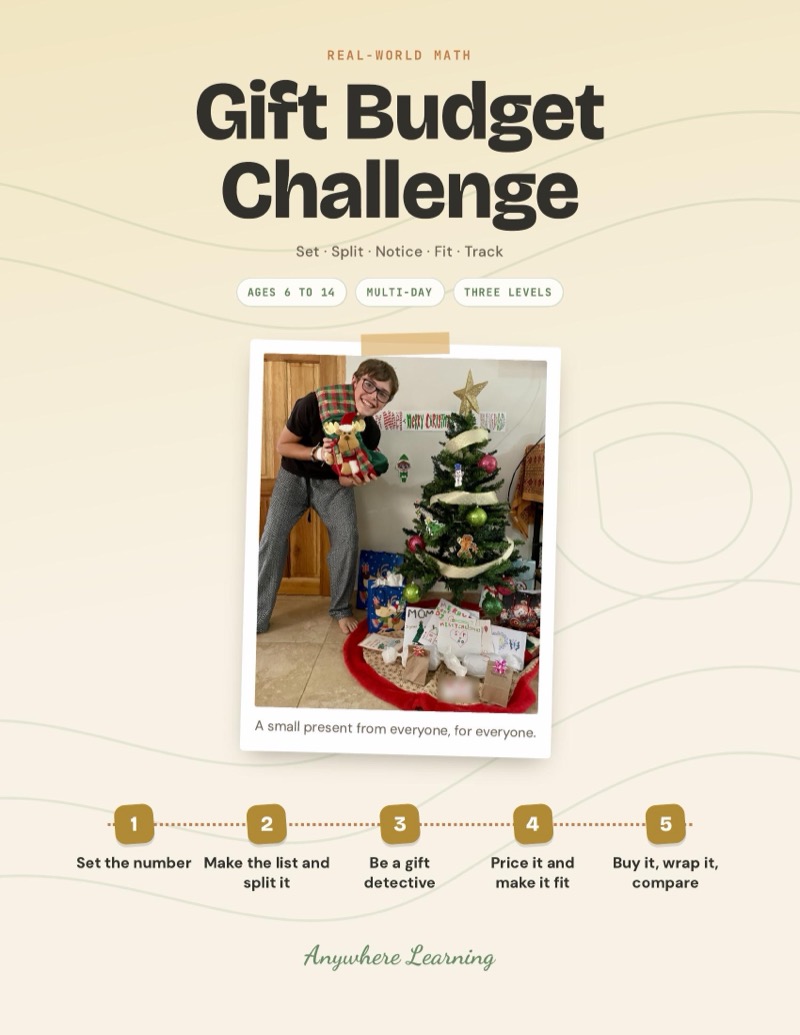
For a friend’s birthday party, they don’t have to bring a present if they don’t want to. That is their call. Christmas is different. Everyone in the family buys or makes a little present for every other person in the family, and they all go in the Christmas stockings. Small is the whole idea. It is not about how much it cost, it is about thinking of each person.
That stocking rule is where this challenge comes from. When your money is your own and every person in the family needs something, you have to plan.
The math inside a gift budget
You do not have to plan any of this. It comes up on its own when the money is real and the list is long. Your job is to ask the questions and let them do the numbers.
- Division: the total split across the list, and what to do when it does not divide evenly.
- Decimals and money: $6.67 each, $12.49 plus $3.75, and the change at the register.
- Percentages: sales tax added at the till, and "30% off" signs that may or may not be a deal.
- Unit prices: a 3-pack against a single, and cost per gift when they make a batch of something.
- Estimation: rounding every price on the list in their head to see if they are close.
- Budgeting and trade-offs: a first total that runs over and the decision about who gets less, or something different.
It uses the same money skills and real-world math kids practise all year, just with a deadline and people they love on the other end.
How to run a holiday budget challenge, step by step
Six steps. Most kids get through the planning in two or three sittings, then the shopping and making take as long as they take. The one rule for you: they do the numbers, you check them.
Step 1: Decide whose money it is and set the number
There are two ways to do this, and both work. If your kid has their own money from chores, a small business or birthday cash, they set their own gift budget and it comes out of their savings. That is how we do it, and deciding the number is part of the lesson: how much of what I have do I want to give away? If they do not have money of their own, you give them a family gift budget for the people they want to give to. Either way, it ends up as one real number: "I have $40 for gifts." Not "try not to spend too much."
For younger kids, put the budget in an envelope as real bills. Watching the envelope get thinner after each store teaches more than any number on a screen.
Step 2: Make the list and do the first division
Who are they giving to? Parents, siblings, grandparents, a best friend, a teacher, the neighbour who shovels the driveway. Write every name down. Then the first piece of math: the budget divided by the number of people.
With $40 and six people, that is $6.66 and a bit, so $6.67. That answer is the best moment of this step. You cannot spend $6.67 on everyone and have it come out even, and they usually figure out fast that not everyone needs the same amount anyway. A little sister might get more than a teacher. Two grandparents might share one gift. Let them decide, as long as the total still adds up.
Step 3: Pick the gift before the price
For each person, one question first: what would they actually love or use? Not "what can I get for $6?" Start with the person, then go look at prices. It keeps the challenge about giving, and it is also where the best ideas come from.
Homemade counts, and it is not free. If they want to bake for the grandparents or draw something for a parent, the materials go on the list too. More on that below, because a homemade batch is some of the best math in the whole project.
Step 4: Price everything, including the hidden costs
Now every gift gets a real price, from a store, a flyer or a website. Then the costs kids always forget:
- Tax. If your area adds sales tax at the register, a $10 gift is not $10. Have them add it before they get to the till, not after.
- Wrapping, tape, cards and gift bags. They come out of the same envelope.
- Shipping, if a gift has to be mailed to a cousin or a grandparent far away.
- Packs. A 3-pack of something for $9 is $3 a gift if it really covers three people. If they only need one, it is a $9 gift.
Sale signs are worth a pause too. "30% off $20" is $14, which is a deal only if they were going to spend $20 on that person in the first place.
Step 5: Make it fit
The first total will be over. It nearly always is, and that is the part to protect. Do not rescue it. Ask them one question: which gifts matter most to you? Then let them cut, swap or make. Here is what that can look like with round, made-up prices. Use real ones from your own stores.
- 1First list on a $40 budget: board game for a brother $22, mug for Grandma $12, chocolate for Grandpa $8, candle for Mom $14, socks for Dad $10, notebook for a best friend $6, wrapping $5. Total: $77.
- 2Cut 1: the grandparents share one gift, a tin of homemade cookies, about $5 instead of $20.
- 3Cut 2: a card game the brother will actually play, $9 instead of $22.
- 4Cut 3: a framed drawing for Mom instead of the candle, $3 for the frame.
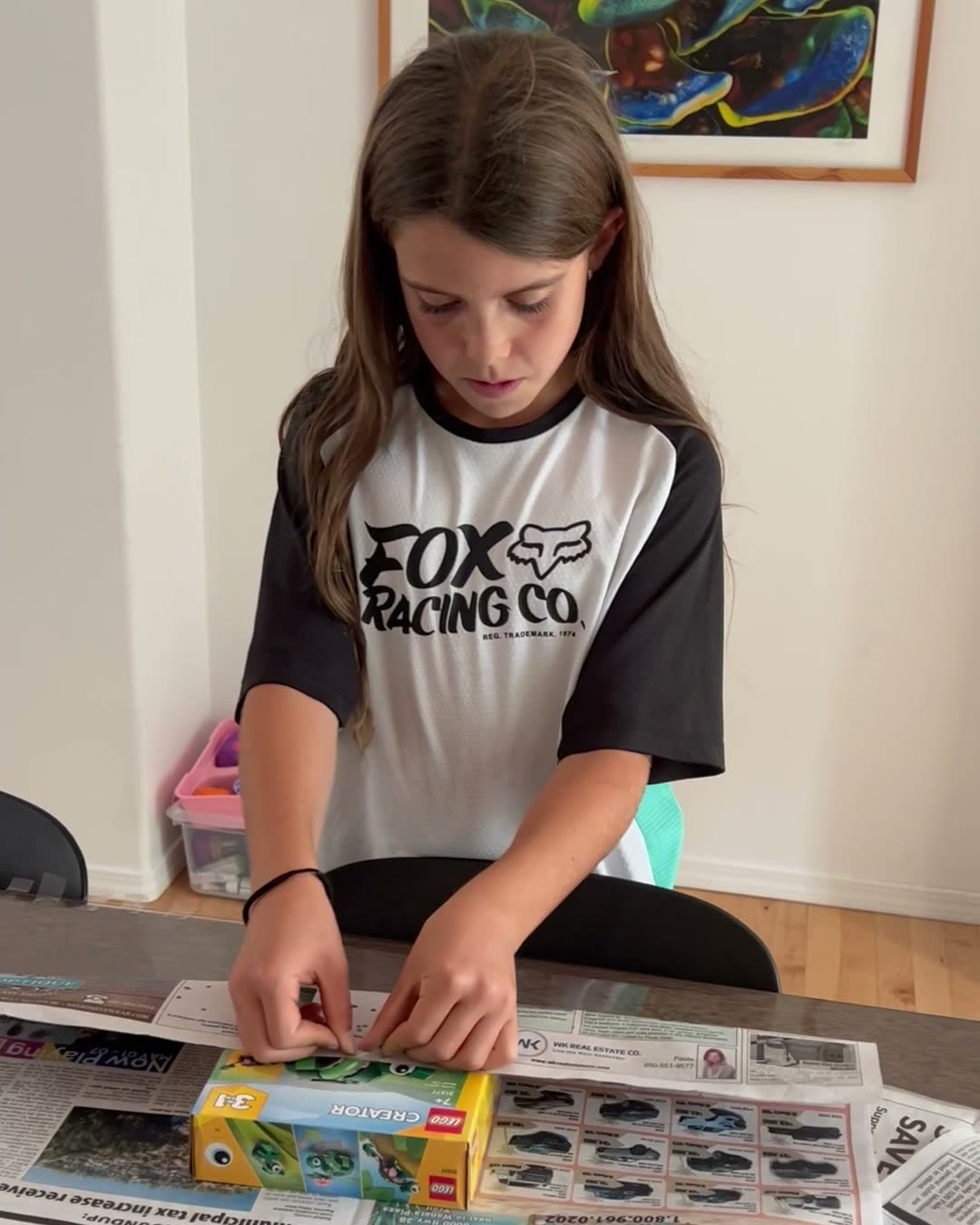
- 5Cut 4: newspaper instead of wrapping paper, free instead of $5.
- 6New total: $5 plus $9 plus $3 plus $10 plus $6 is $33. Seven dollars left, and they get to decide what happens to it.
Each cut is a subtraction and a decision. Kids defend the choices they made themselves, and most of the time the gifts they end up with are more personal than the first list.
Step 6: Buy it, track it, compare
Then they shop. They carry the list, they pay, they count the change. Every receipt goes in the envelope. When everything is bought and made, sit down together and lay the receipts next to the plan. Which gift cost more than they guessed? Did tax catch them anywhere? How much is left? That comparison is where estimating gets better, and next year the plan will be closer.
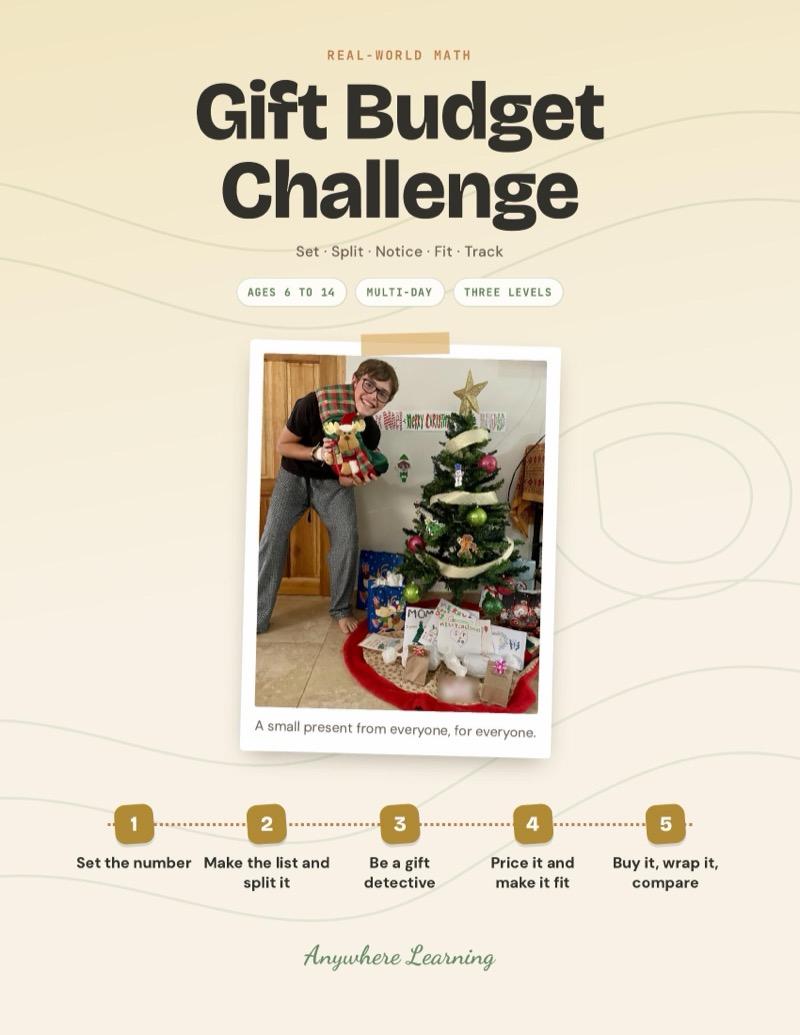
In the Membership
Gift Budget Challenge
Want the full version? The Gift Budget Challenge guide walks your kid through every step, and adds a gift detective step for finding what each person would really love, a gift idea bank by price, tax worked out in their head, and homemade cost-per-gift math, with three levels for every step. It works for birthdays too.
Homemade gifts are a math project of their own
Baking, crafting, or making a batch of anything turns into cost-per-gift math, which is one of the most useful money ideas a kid can learn. Here is a cookie version with made-up prices.
- 1Ingredients for one batch: $9. The recipe makes 36 cookies.
- 2Twelve cookies per tin is 3 tins. $9 divided by 3 is $3 of cookies per gift.
- 3Tins are $1.25 each, so each gift costs $4.25.
- 4Want 5 gifts instead of 3? That is 60 cookies, so the recipe has to scale by 5/3, or two batches with 12 cookies left over for the family.
Then the honest question: is $4.25 and an afternoon of baking a better gift for this person than a $4 store-bought one? Sometimes yes, sometimes no. Both answers are fine, and thinking it through is the point. If your kids already love the kitchen, the kitchen learning lab has more ways to do math with a mixing bowl.
Adapting it by age
Ages 6 to 8
Small list, small numbers. Three or four people, a $20 budget, prices rounded to whole dollars, cash in an envelope. They count the money with you, pick one thing for each person, and pay at the register themselves. That alone is a big deal at six.
Ages 9 to 11
The full challenge. The first division with a decimal answer, real prices with tax added, a homemade gift costed out, and a simple table with planned and actual columns. They present the plan to you before anything gets bought.
Ages 12 to 14
They run it like a project. Their own money if they have it, a 10% buffer held back for surprises, unit prices on anything in packs, shipping deadlines for gifts that need mailing, and a one-page review after the holidays: planned against actual, and what they would do differently next year.
What to say while they plan
You are the bank and the sounding board, not the planner. Questions do more than answers: "What would she actually use?" "Does that price include tax?" "What happens to the rest of the list if you spend $22 on him?" If they want to blow the whole budget on one person, let them do the math out loud and see what is left for everyone else. They usually change their mind on their own.
Keep the price out of the gift itself. The lesson is planning and giving, not that a cheaper gift means less love. A kid who learns that a $3 frame around their own drawing can be the gift someone keeps for years has learned something a lot of adults are still working on.
Want this as a free printable? Grab the The Life Skills Checklist: 28 Skills for Kids, free to read, and the printable version lands in your inbox.
The holidays already come with a list, a deadline and real money. Hand over the envelope this year and let your kid do the planning. You might be surprised by what they choose when the numbers are theirs.
And if you want projects like this ready to go all year, with nothing to plan the night before, that is what the Anywhere Learning membership is for: real-world, hands-on activities for ages 6 to 14, from budgets and road trips to business pitches and science you can do outside.