- 1Why bird watching is the best entry point to nature observation
- 2What you actually need
- 3Where to start: your own backyard
- 4The 10 backyard birds worth learning first (North America)
- 5How to actually identify a bird
- 6The "patch" idea: one spot, every week
- 7The science skills hiding inside this
- 8What to do with kids who lose interest fast
- 9Frequently asked questions
Bird watching has a reputation problem. People picture retirees in khaki vests with $800 binoculars and a tattered field guide, whispering Latin names. That version exists. It is also completely unnecessary for getting started with a kid.
The truth is, bird watching might be the lowest-barrier nature activity that exists. You do not have to drive anywhere. You do not have to know any birds before you start. You do not need expensive gear. And unlike most outdoor activities, the subject (birds) is already showing up at your window whether you invite them or not.
This guide walks through exactly what you need, where to start, the 10 backyard birds worth knowing first, and how to make the habit stick with kids who lose interest in 12 minutes flat. (For the bigger picture of why this kind of observation matters, our nature-based learning guide has the research.)
Why bird watching is the best entry point to nature observation
Most nature activities require you to go somewhere. A forest, a creek, a meadow, a trail. Bird watching does not. Birds are everywhere. They are on the wire above your driveway, in the bush by your front door, in the parking lot of the grocery store. Urban kids have backyard birds. Apartment kids have window birds. There is no version of this activity that requires you to live somewhere "nature-y."
Birds also do interesting things. They fight, they sing, they build, they feed each other, they show up suddenly and vanish. That visual drama matters for kids who would zone out staring at a leaf for 20 minutes. A robin yanking a worm out of the grass is more compelling than almost anything on a screen, and you do not have to make it more entertaining than it already is.
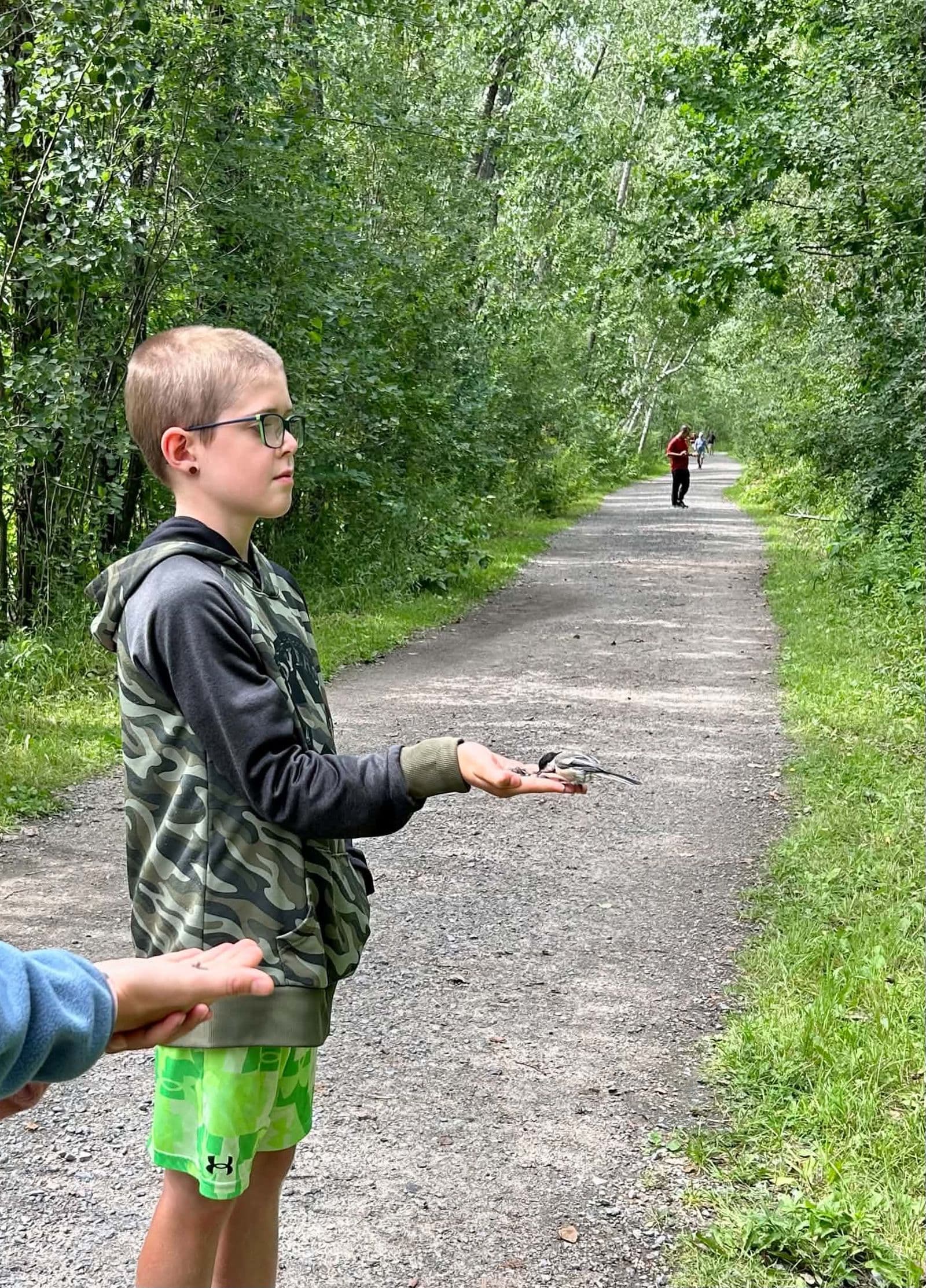
Bird watching also rewards attention in a way kids can feel. The longer you sit still, the more shows up. That is a hard lesson to teach with words. It is an easy one to learn when a chickadee lands three feet from your face because you stopped moving for two minutes.
What you actually need
Here is the gear list. The whole thing.
- A pair of cheap binoculars. Anything between $20 and $30 is fine for a kid. Look for 8x21 or 8x25 on the box. Skip anything advertised as "kids binoculars" with bright colors and bad lenses. A real adult pair on the cheap end of the range beats a toy pair every time.
- The Merlin Bird ID app. Free. Made by the Cornell Lab of Ornithology. Identifies birds by photo, by sound, or by a short questionnaire. Download the regional bird pack before you go outside so it works offline.
- Optional: a simple bird feeder you can stick to a window with suction cups, or hang from a tree branch. A bag of black-oil sunflower seed covers most backyard birds in North America.
- Optional: a notebook for sketches and notes. If you already keep a nature journal, birds slot right in.
Total cost to get started: under $30. You do not need a field guide. You do not need a tripod. You do not need a spotting scope. The app and the binoculars are 95% of what makes this work.
Open the app, hit Sound ID, hold your phone toward a singing bird, and watch it identify the species in real time. It will pick up birds you cannot even see, sometimes three or four at once. The first time a kid sees their phone correctly name a bird hidden in a tree, they get genuinely hooked.
Where to start: your own backyard
You do not need to drive to a wildlife refuge. Start at home. Or the nearest park. Or the strip of grass behind your apartment building. The whole point of bird watching with kids is that the birds come to you, so trying to overoptimize the location is a trap.
The first session is simple. Sit outside for 15 minutes, around dawn or in the hour before dusk if possible. Bring binoculars and the app. Do not try to identify everything. Just watch. Point out anything that moves. Let your kid hold the binoculars (they will be clumsy with them, that is fine). Open Merlin once or twice when you hear something you do not recognize.
That is the entire first outing. If your kid lasted 12 minutes, that is a win. If they lasted 4 minutes and then wanted to go back inside, also fine. Birding sessions get longer naturally once kids start recognizing species, because recognition is the dopamine hit that keeps them going.
The 10 backyard birds worth learning first (North America)
There are roughly 900 bird species in North America. You do not need to know any of them to start. But knowing 10 common ones gives your kid the ability to walk outside and name something within the first minute, which is the single biggest motivator for sticking with it.
Here is the starter list. These show up in most backyards across the continent, with regional variations.
- 1House sparrow. Small, brown, lives in flocks, will eat almost anything. The most common urban bird in the world.
- 2American robin. Orange-red breast, grey back, hops around lawns yanking worms. Easy to spot, easy to remember.
- 3Blue jay. Loud, bright blue, with a crest on its head. Will scream at you. Hard to miss.
- 4Black-capped chickadee. Tiny, with a black cap and bib. Bold, will land close to humans. Sings its own name (chick-a-dee-dee-dee).
- 5Northern cardinal. The male is bright red with a crest, the female is warm tan with red highlights. Year-round in most of the eastern US.
- 6Mourning dove. Soft grey-brown, with a sad cooing call you hear constantly without knowing it is a bird. Sits on wires a lot.
- 7American crow. Large, all black, very loud, very smart. Usually in groups. Often confused with ravens (ravens are bigger and have wedge-shaped tails).
- 8European starling. Iridescent black with white spots in winter. Forms massive flocks. Invasive, but unavoidable.
- 9House finch. Small, brown with streaky chests, males have red heads and chests. Eats seed at feeders constantly.
- 10Downy woodpecker. Small, black and white, with males having a tiny red patch on the back of their head. Drills on tree bark and metal poles.
Print this list, or better, have your kid quiz themselves with Merlin's photo gallery. Once they know these 10, they can identify the bird in the backyard about 70% of the time, which is the threshold where it starts to feel like a real skill.
In the Membership
Nature Walk Task Cards
Nature walk task cards for kids ages 6-14: turn any walk into focused outdoor learning. Low-prep, any trail, any season.
How to actually identify a bird
Identifying a bird is not memorizing 900 species. It is asking a few questions in a specific order. Teach your kid to look for these in this sequence:
- Silhouette and size. Is it bigger than a sparrow, robin-sized, or crow-sized? Round or slender? Long tail or short tail?
- Color and pattern. Solid color or patterned? Stripes, spots, patches? Bright or muted?
- Behavior. Is it on the ground, in a tree, on a wire? Hopping or walking? Pecking, hovering, swooping?
- Sound. What does it sound like? Song, chirp, screech, drumming?
- Habitat. Where is it? Open lawn, dense bush, near water, high in trees?
Real birders run this checklist in about 4 seconds without thinking about it. With kids, slow it down. Ask the questions out loud. "Is it bigger or smaller than a robin?" "What is it doing with its tail?" Practicing the question sequence matters more than getting the ID right.
The "patch" idea: one spot, every week
Real birders have a "patch." A local spot they return to over and over, year after year, until they know its birds better than the people who own the land. The patch concept works beautifully for kids because it removes the pressure to seek novelty and replaces it with the satisfaction of becoming an expert on one small place.
Pick a patch. Your backyard, the park down the street, the trail behind the school. Go there once a week. Keep a list of birds seen each visit. Within two months, your kid will start predicting which birds will be there, noticing when something unusual shows up, and recognizing the resident birds by sight before they even raise the binoculars. That is when the practice goes from activity to skill.
The science skills hiding inside this
Bird watching looks like a hobby. Underneath, it trains the same skills a working field biologist uses every day:
- Observation: noticing field marks, behavior, habitat, and sound without being prompted
- Classification: sorting what you see into families, sizes, color patterns
- Patience: sitting still long enough for something to happen
- Prediction: anticipating which birds will appear based on season, time, and weather
- Record-keeping: tracking lists and dates over time, which is how naturalists have worked for 300 years
None of this needs to be framed as "science." Kids who bird watch for a year are doing the same cognitive work that a college ecology lab teaches, just without anyone telling them it is school.
What to do with kids who lose interest fast
Not every kid will sit and watch birds for 30 minutes. Most will not. Here is what works.
Want this as a free printable? Grab the Nature Walk Checklist: 50 Ideas for Kids, free to read, and the printable version lands in your inbox.
- Keep sessions short. 10 to 15 minutes is plenty at the start. Two short outings a week beats one long one.
- Lead with the app, not the binoculars. The Sound ID feature is more dopamine-heavy for short-attention kids than scanning through binoculars.
- Add a feeder to a window. Even kids who hate sitting outside will watch a window feeder while they eat breakfast.
- Pair it with something else. Birding on a walk. Birding while playing in the yard. Birding during a seasonal scavenger hunt. It does not have to be a stand-alone activity.
- Gamify it gently. Count species per outing. Keep a running yard list. Race to spot a new one. Avoid making it competitive between siblings if that backfires.
- Drop it for a season. Birding does not have to be year-round. Most kids cycle in and out of interests, and birds will still be there when they come back.
A kid who has learned to sit still and watch a bird has learned something most adults have forgotten.