There is a specific dread that shows up in late summer for homeschool parents. The calendar is turning, other families are posting first-day-of-school photos, and you know you need to get everyone back into some kind of rhythm. But your kids have spent two months feral and happy, you have spent two months off the clock, and the thought of restarting feels like pushing a stalled car uphill.
Here is the reframe that helps. You are not flipping a switch. You are easing a household back into motion, and that is a process, not an event. The parents who have the roughest Septembers are almost always the ones who tried to go from full-summer to full-schedule on a single Monday morning. It does not work, and it is not supposed to.
This is a practical guide to getting back into homeschool after summer without the fight: how to ramp up over a week or two, why a routine will save you where a rigid schedule will break you, and what a realistic back to homeschool day actually looks like as you start a new homeschool year. If you are newer to all of this, our homeschool journey guide covers the bigger picture; this post is just about the reset.
Why restarting homeschool is harder than back-to-school
When kids go back to traditional school, an entire external system does the heavy lifting. There is a bell, a bus, a start time, a teacher, and twenty-five other kids all moving in the same direction. The structure exists outside the child, so the child just steps into it.
Homeschooling has none of that. There is no bell. There is no bus. There is just you, deciding when the day starts, what it holds, and how to pull everyone back from summer mode. The structure has to be built, by you, from scratch, every year. That is why the homeschool restart can feel so heavy. It is not that you are bad at it. It is that you are doing a job that an entire institution normally does, and you are doing it while also being the parent, the cook, and the person who has to find everyone shoes.
Naming that helps, because it lowers the bar. You are not failing if the first week is bumpy. You are rebuilding an entire daily rhythm by hand, and that takes a minute.
Start before you start
The single best thing you can do is refuse to cold-start. Do not go from a lazy August to a full September overnight. Give yourself a ramp, ideally a week or two before you want the real rhythm to click in.
A gentle ramp looks like this:
- A week out, start nudging bedtimes and wake times back toward where you want them, fifteen minutes at a time. Nothing resets a household faster or harder than sleep, so fix that first.
- Bring back one small anchor before you bring back everything. A morning read-aloud. A shared breakfast at the table. One predictable thing that signals the day has a shape.
- Do a low-stakes trial day or two. Not a full schedule, just a taste: a bit of reading, a bit of math, a walk. Let everyone remember what learning-together feels like before the real load arrives.
- Prep the environment while the kids are still in summer mode. Restock the pencils, clear the table, set up the space. Walking into a ready space on day one removes half the friction.
The goal of the ramp is to make the first real week feel like a continuation, not a shock. By the time you officially start, the household is already half in motion.
Build a routine, not a schedule
This is the distinction that saves homeschool years. A schedule is tied to the clock: math at 9:00, reading at 9:45, science at 10:30. A routine is tied to a sequence: first we do the morning basket, then the hard subject while brains are fresh, then a break, then the lighter stuff. A schedule tells you what time it is. A routine tells you what comes next.
Schedules break the first time a kid melts down at 9:15, because now the whole day is behind and everyone feels like a failure. Routines bend. If the morning runs long, you are still just moving through the same sequence, later. Nothing is broken. The order holds even when the clock does not.
This does not mean no structure. It means the structure is a rhythm the kids can predict and internalize, not a timetable you have to enforce. Over a few weeks, a good routine runs itself: the kids know that after breakfast comes the read-aloud, and after the read-aloud comes math, without you announcing it. That is the whole goal. If you want to see how different families arrange the same building blocks, our sample homeschool schedules lays out three real rhythms from loose to structured.
The easiest way to build a routine kids can feel is to hang it on the fixed points that already exist: before breakfast, after breakfast, before lunch, after lunch. Kids have a strong internal sense of the meal rhythm even when they have no sense of clock time. Use it. "We do our learning block between breakfast and lunch" is a rhythm a seven-year-old can hold. "Math is at 9:00" is not.
What a back-to-homeschool day can actually look like
There is no single right rhythm, but here is a realistic, gentle shape for the first few weeks back. Adjust the blocks to your kids ages and your family. The point is the sequence, not the specifics.
- 1Slow open. Breakfast together, no screens, maybe a read-aloud or a chat about the day. This is the on-ramp. It signals the day has started without a jolt.
- 2One focused block. Do the hardest or most-resisted subject first, while everyone is fresh and willpower is high. Keep it short, especially in week one. Twenty focused minutes beats an hour of dragging.
- 3Move the body. A real break: outside, a snack, running around. Not a screen. Movement resets attention better than anything.
- 4A second, lighter block. Reading, a project, a hands-on activity, something they enjoy. This is where curiosity-led learning lives.
- 5Open afternoon. Free play, an outing, a personal project, quiet time. Protect this. The afternoon margin is where the best unstructured learning happens, and it is what makes homeschooling sustainable for you.
Notice how short the actual "school" part is. Two focused blocks with a real break between them is plenty, especially in the first weeks and especially for younger kids. You are not recreating a six-hour school day. You never needed to.
Let the kids help build it
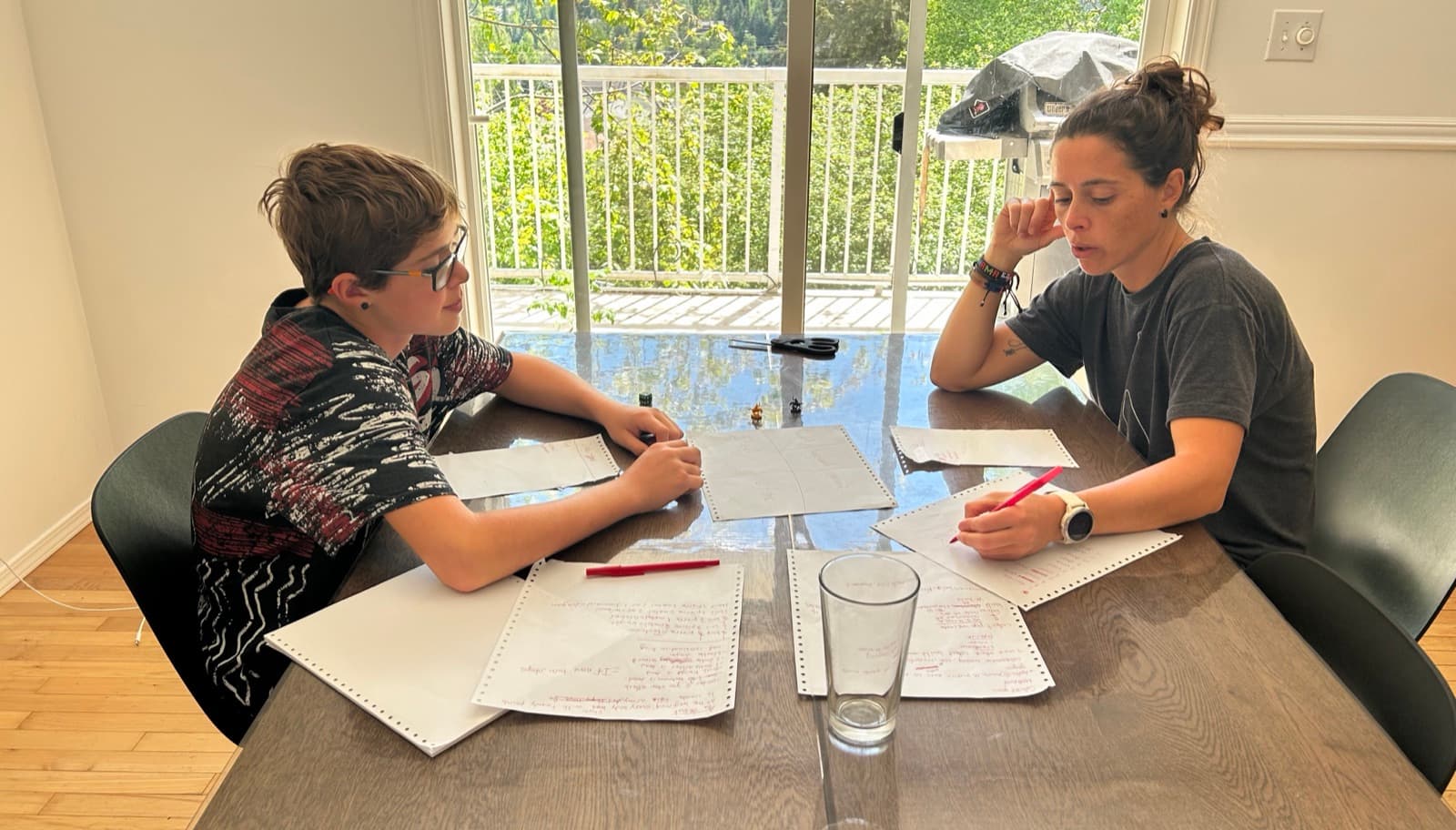
A routine the kids helped design is a routine they will actually follow. Before the year starts, sit down together for fifteen minutes and build it as a family. Ask them what worked last year and what did not. Ask what they want to learn about. Ask when they focus best. Kids are surprisingly honest and often more ambitious than you expect.
When a kid has a say in the shape of their day, the daily battle mostly disappears, because it stopped being your rule and became their plan. Even small choices help: which subject comes first, whether the read-aloud is morning or bedtime, what the reward is for finishing the focused block. Ownership does more for cooperation than any sticker chart.
In the Membership
Time & Energy Planner
A kid-led way to map out the week together, so the routine is something they own rather than something you enforce.
The mistakes that wreck the first month
A few predictable traps, and how to sidestep them:
- Too much, too fast. The most common one. You are rested and motivated in August, so you plan an ambitious full-load schedule, and by week two everyone is fried. Start at half of what you think you can do and build up.
- Recreating school at home. Trying to fill a six-hour day with seat work because that is what "real school" looks like. It is not what home learning needs. A focused couple of hours is plenty.
- No margin. Scheduling every hour leaves nothing for the sick day, the meltdown, the beautiful afternoon you want to spend outside. Build in slack on purpose.
- Comparing week one to a veteran family in October. Everyone finds their rhythm at a different pace. Your messy first week is not their polished third month. Run your own race.
- Abandoning it the first hard day. A routine takes a couple of weeks to settle. The first bad day is not evidence it failed. It is just a bad day. Keep going.
If it falls apart by week two
It might. That is normal, not a verdict. If the routine is fighting you by the second week, the usual fix is to do less, not more. Cut the load in half. Drop to one focused block. Add more outside time. A routine that is too heavy will collapse; a routine that is too light can always be built up.
And if the resistance runs deeper than a rocky restart, it might not be a routine problem at all. If your kids just left traditional school, they may still be deschooling, and pushing a full routine too early will backfire. If you are the one running on empty, that is worth naming too, because homeschool burnout does not fix itself with a better schedule. Sometimes the most productive thing you can do in week two is take a day off and reset.
Want low-prep, open-and-go activities to anchor your homeschool days? Our free guide is full of real-world learning ideas you can use this week, no curriculum required.
Restarting homeschool after summer is not about willpower or the perfect planner. It is about easing in, building a rhythm the kids can feel, and giving yourself permission for the first weeks to be imperfect. Go slow, keep the focused part short, protect the afternoon, and let the routine settle over a couple of weeks instead of demanding it on day one.
If you want ready-to-use activities that slot straight into those focused blocks, that is exactly what the Anywhere Learning membership is built for: low-prep, real-world learning for ages 6 to 14 that you can open and follow without planning the night before. It makes the back-to-homeschool reset a lot lighter, because the "what are we even doing today" part is already handled.